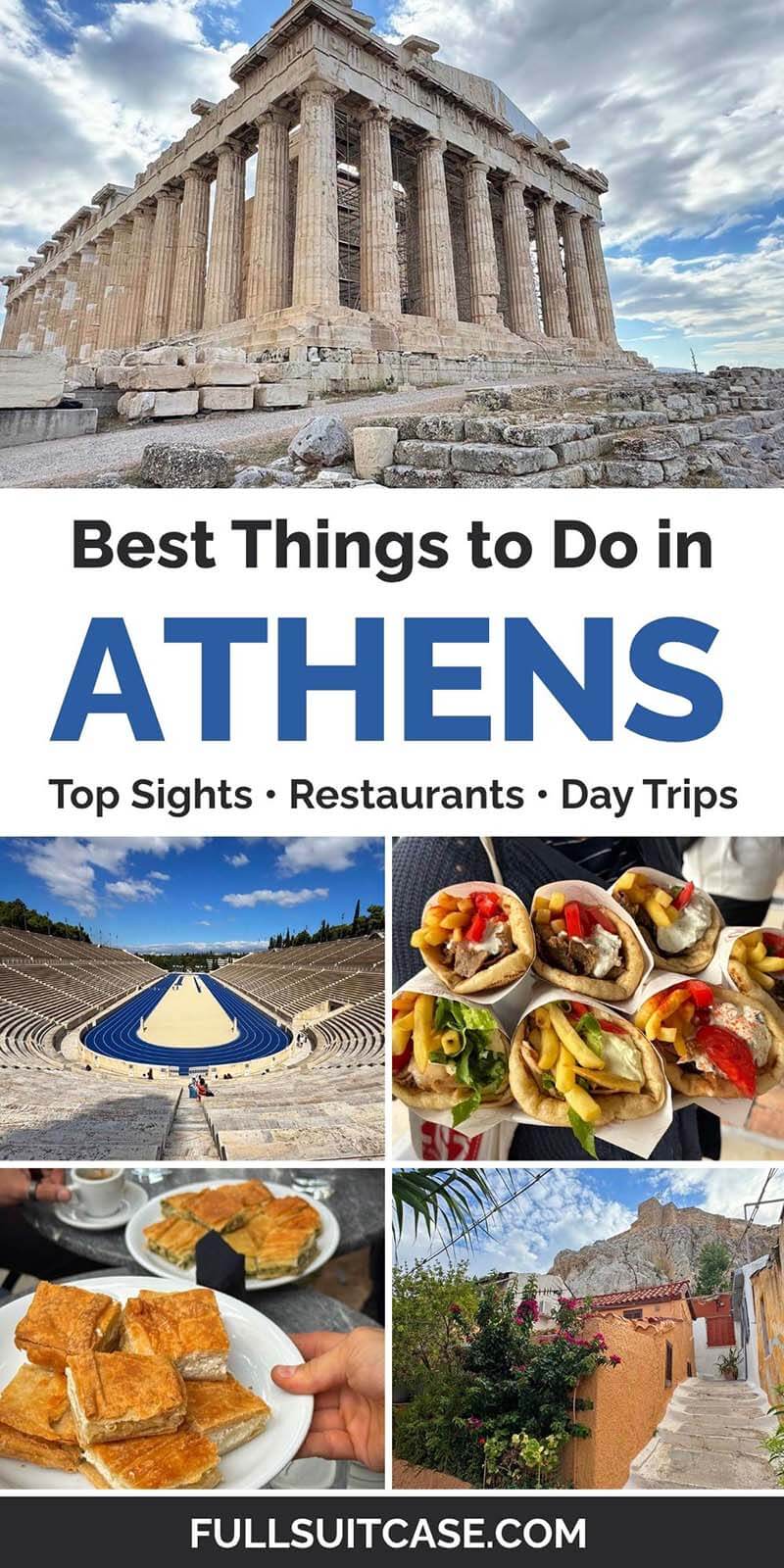
Best Things to Do in Athens: Our Favorites & Personal Tips (+Map)
This site contains affiliate links, which means that we may earn a small commission, at no cost to you, for qualifying purchases. It supports the work that goes into keeping this content free. Thanks for reading! More info: Privacy Policy.
Planning a trip to Athens and wondering what to see and what’s truly worth your time? In this guide, we share the best things to do in Athens, from famous landmarks to traditional food, viewpoints, and our favorite day trips, with honest recommendations and personal tips.
We spent a week exploring Athens on foot and by bike, trying local specialties, visiting ancient sites, and taking trips beyond the city. Some of the “must-sees” impressed us less than we expected. Other places and experiences became unexpected favorites.
For us, Athens didn’t have quite the same long list of must-see attractions as Rome or Barcelona. What made it special was the whole experience: walking among 2,500-year-old buildings, exploring lively neighborhoods, trying Greek food, and enjoying Acropolis views from rooftops around the city.
It felt very different from any other city trip we’ve done in Europe, more relaxed, perhaps. Below, we share what we’d do again, what we’d do differently, and what we wouldn’t prioritize on a short visit.
Map of the Best Places to See in Athens
Below, you can find our map of the places mentioned in this guide, including Athens’ main sights, viewpoints, neighborhoods, and our recommended rooftops and restaurants. Use it to see what’s close together and plan your sightseeing.
How to use this map: Zoom with your mouse or fingers. Select an icon for place details or the top-left menu for the full list. Click the star beside the title to save the map to your Google account. Find it in Google Maps under “You” → “Maps” on mobile or “Saved” → “Maps” on a computer using the same account.
Here are the best things to do in Athens:
1. Acropolis & Parthenon
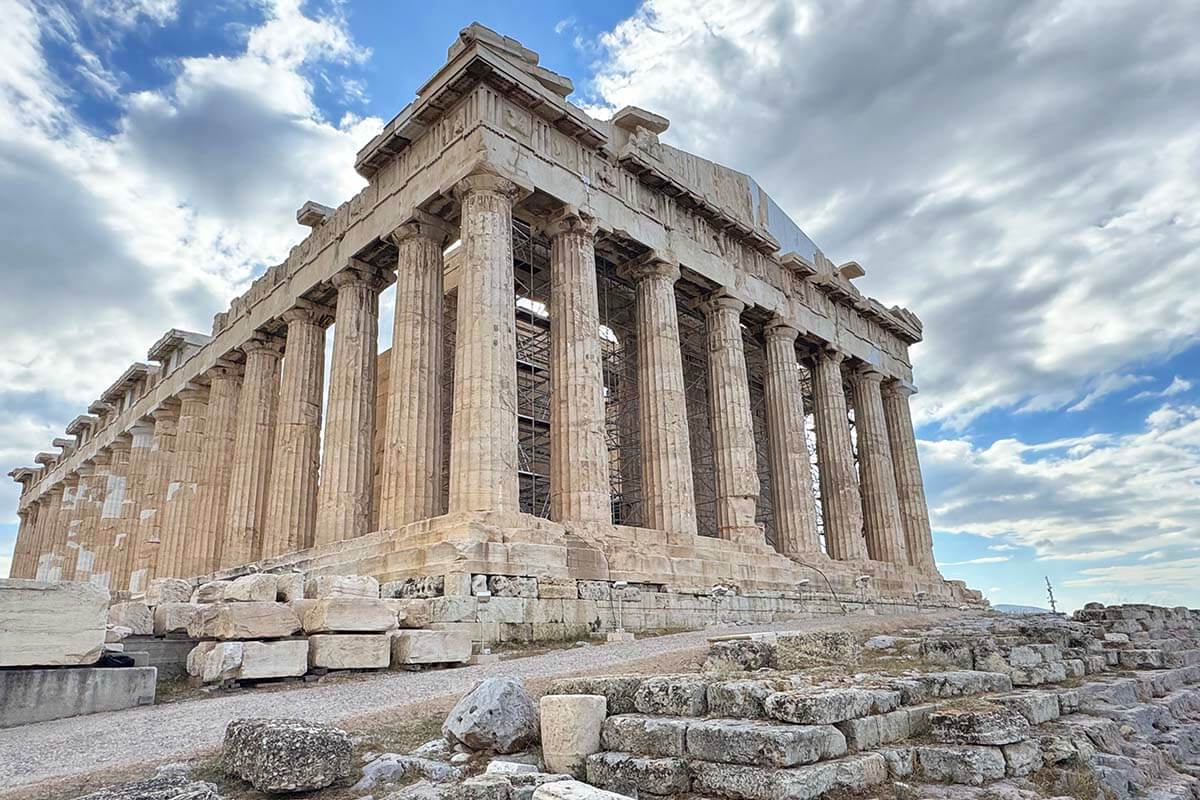
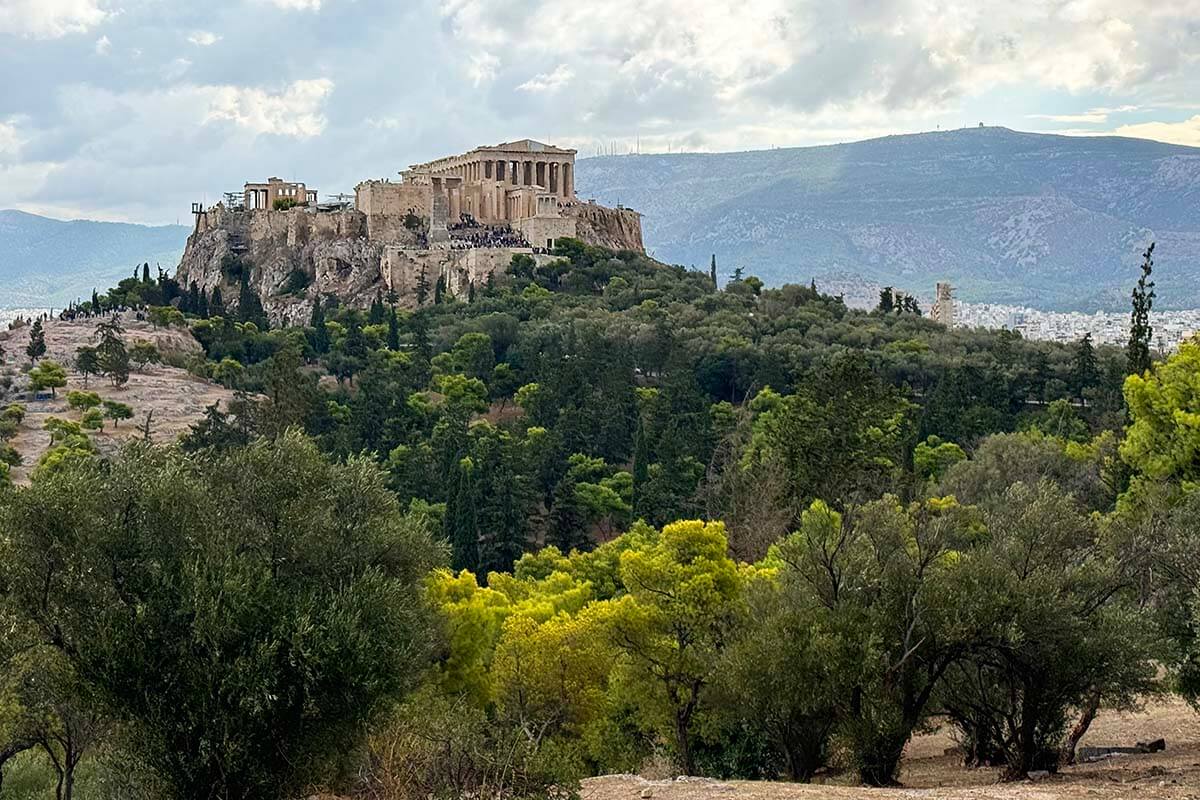
The Acropolis is a must-see, and no first trip to Athens would be complete without visiting it. Standing on a rocky hill above the city, this ancient complex is home to the Parthenon, Athens’ most recognizable landmark, and several other important monuments dating back around 2,500 years.
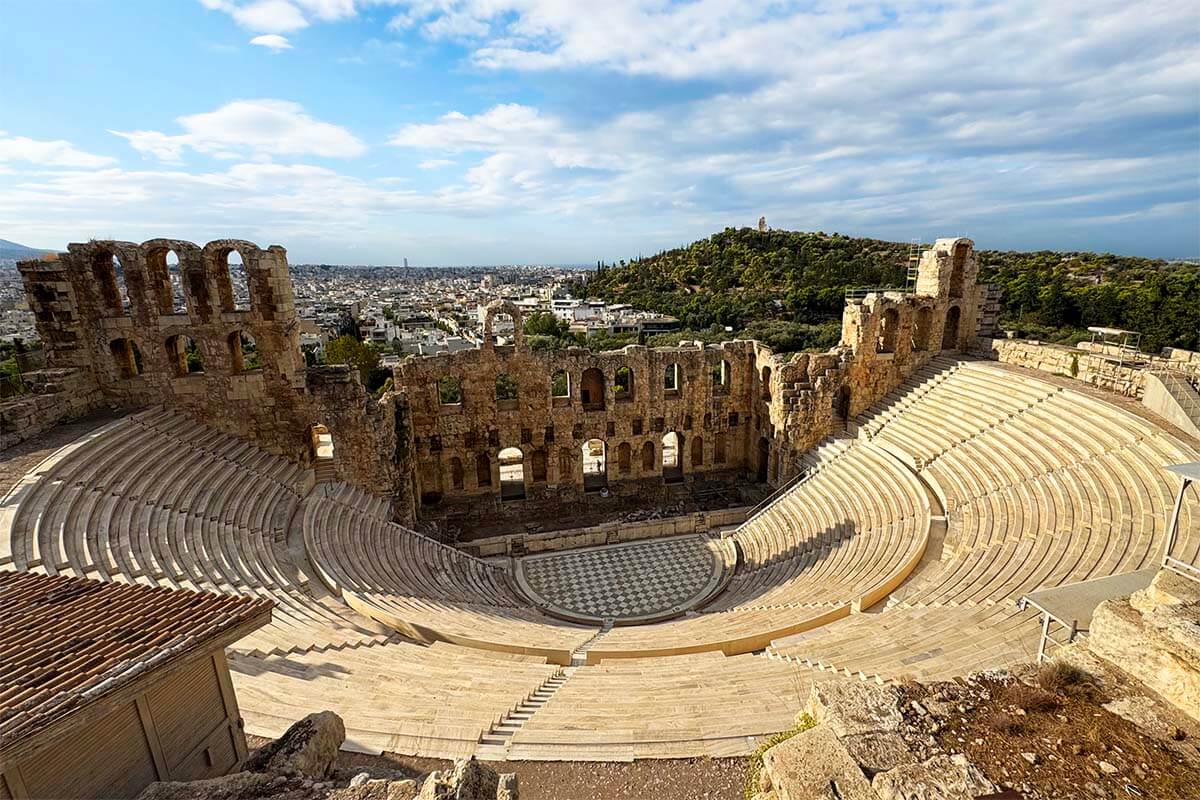
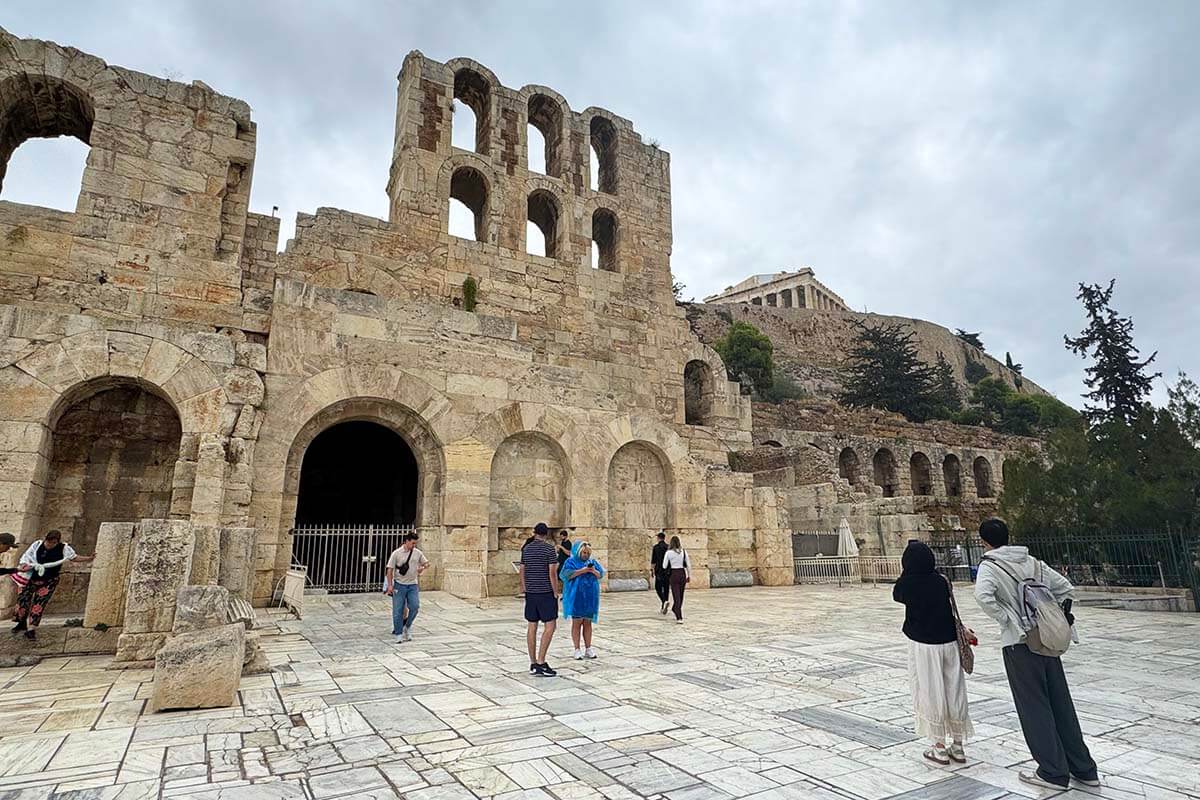
In addition to the Parthenon, look out for the Erechtheion, with its famous porch supported by female figures, and the monumental Propylaea gateway. On the southern slopes, you’ll also find the Theater of Dionysus and the Odeon of Herodes Atticus, an ancient amphitheatre that’s still in use as a performance venue today. Honestly, I found it more impressive than the Parthenon.
We chose to visit Acropolis with this small-group guided tour, and I’d highly recommend having a guide. Unless you already know a lot about the Acropolis, it’s easy to walk around looking at ruins without really understanding what you’re seeing. Hearing the history and stories behind the buildings makes the visit much more interesting and helps you appreciate the importance of this place.
Whether you visit the Acropolis independently or with a guide, you need a timed-entry ticket, which you can buy on the official website. Some tours include admission, while others require you to book it separately. The tour we took sent us instructions for buying tickets for the correct time slot, and we purchased tickets ourselves.
Good to know: The Acropolis can get extremely busy and hot, with very little shade at the top. The ground is uneven, and the worn stone can be slippery, so wear shoes with a good grip. Bring drinking water, and in summer, don’t forget a hat.
TIP: Visit as early as possible for fewer crowds and less heat. In the summer season, I’d choose a first-access Acropolis tour like this one. If you’re visiting in the cooler months, bring an extra layer. We visited on a cloudy day in early October, and it was windy and cold at the top. But as soon as the sun came out, it was warm enough for T-shirts.
Time needed: About 2 hours, plus 15–20 minutes for Areopagus Hill.
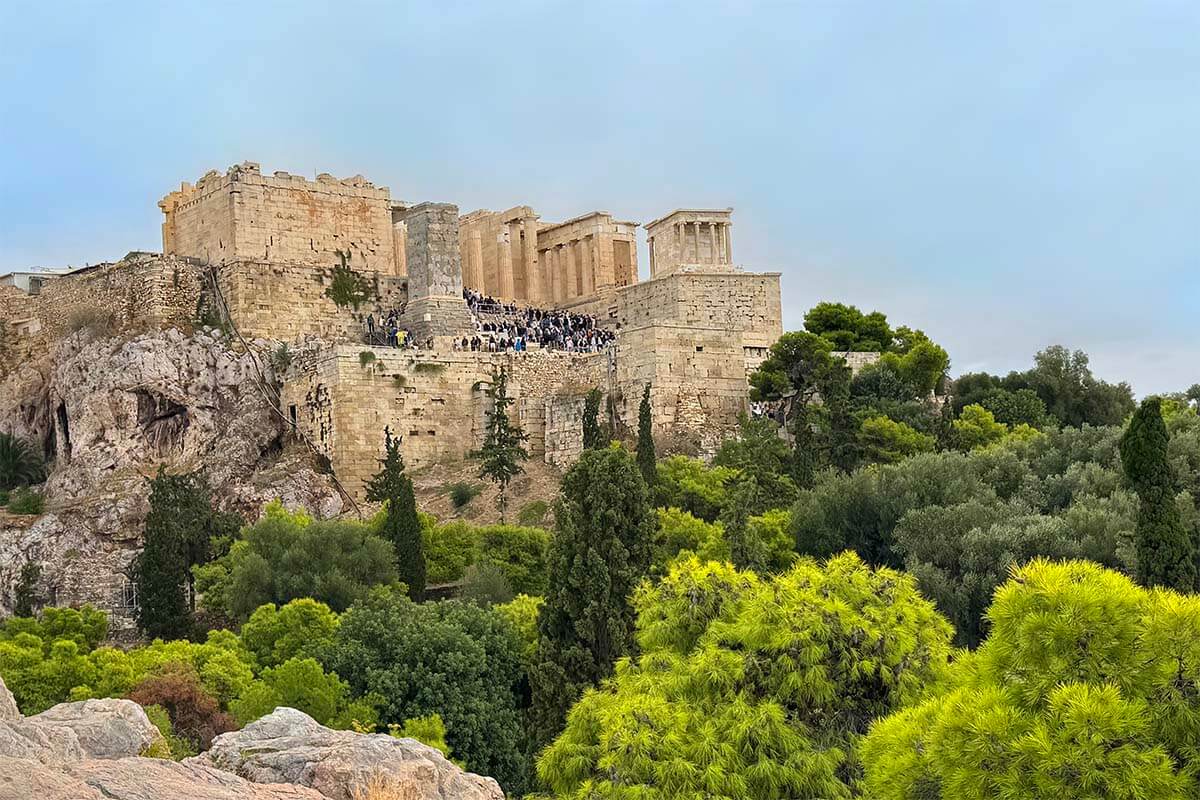
Don’t miss: After your visit, leave through the main exit on the west side and take a short detour to Areopagus Hill, just nearby. This rocky viewpoint is free to visit and offers excellent views of the Acropolis and the city below. Just watch your footing, as the rock can be very slippery in places.
Our take: The Acropolis is absolutely worth doing, ideally with a guide. But Athens is so much more than the Acropolis, so leave time for the other places and experiences in this guide!
2. Acropolis Museum
The Acropolis Museum is just a short walk from the Acropolis entrance, so many people visit the two together. Inside, you can see statues, pottery, and other finds from the Acropolis and its slopes.
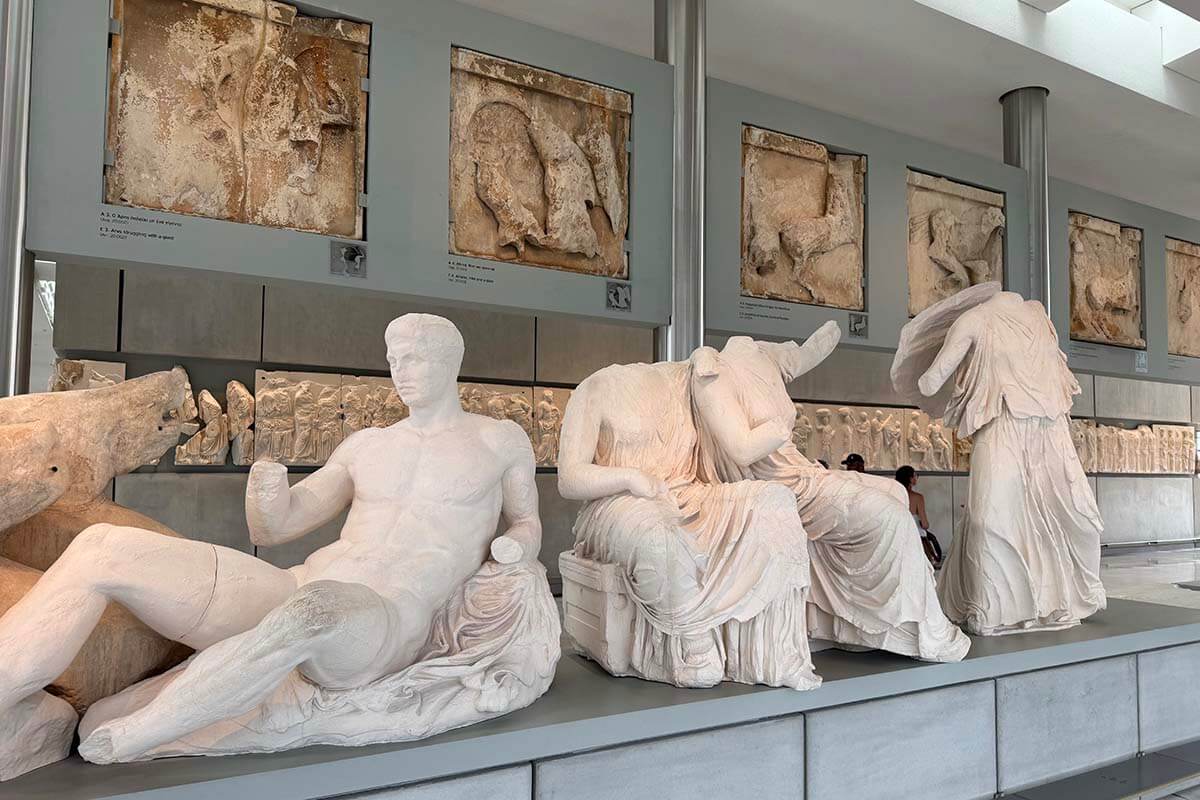
Highlights include the original Caryatids, the female figures that supported the porch of the Erechtheion, and the Parthenon Gallery, where sculptures from the temple are displayed with views of the Acropolis through huge windows.
The modern building is really impressive, with spacious galleries, plenty of natural light, and glass floors revealing ancient ruins below. There are two parts to explore: the main museum and the archaeological excavation underneath, where you can walk through the remains of an ancient neighborhood.
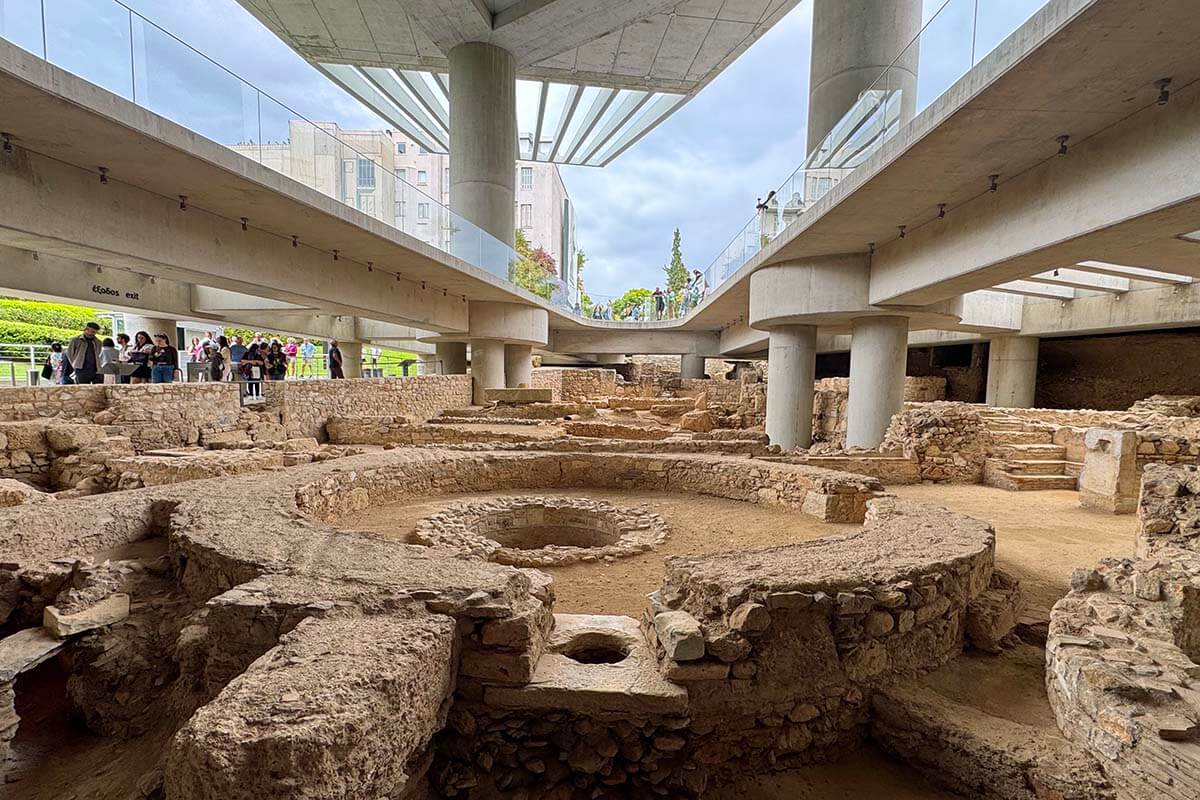
Good to know: The Acropolis Museum ticket covers both the main museum and the excavation, which has a separate entrance from the courtyard. You’ll need to scan your ticket at each entrance, so keep it handy. The Acropolis archaeological site mentioned above requires a separate ticket. You can find ticket and tour options here.
Some guided tours cover both the Acropolis site and the museum. We chose to visit the museum independently, separately from our guided Acropolis tour. Looking back, I’m not sure that was the best decision. The architecture really impressed me, but the exhibits felt a little underwhelming. I think I was missing some of the context that would have made the collection more interesting.
TIP: If you visit independently, use the museum’s free digital audio guide on your phone and bring headphones. It helps explain what you’re looking at, although for me, it’s not quite the same as having a live guide who can answer questions and connect the stories.
Time needed: About 1.5–2 hours, including the excavation beneath the museum.
Our take: The building was a highlight, but I think we would have enjoyed the collection more with a guide. If I were planning this visit again, I’d choose a tour that covers both the Acropolis and the museum. Afterward, you could stop at the museum restaurant, which one of our local guides recommended for its brunch. There are also plenty of restaurants nearby; I’ve marked a few options on our map.
3. Take a Bike Tour of Athens
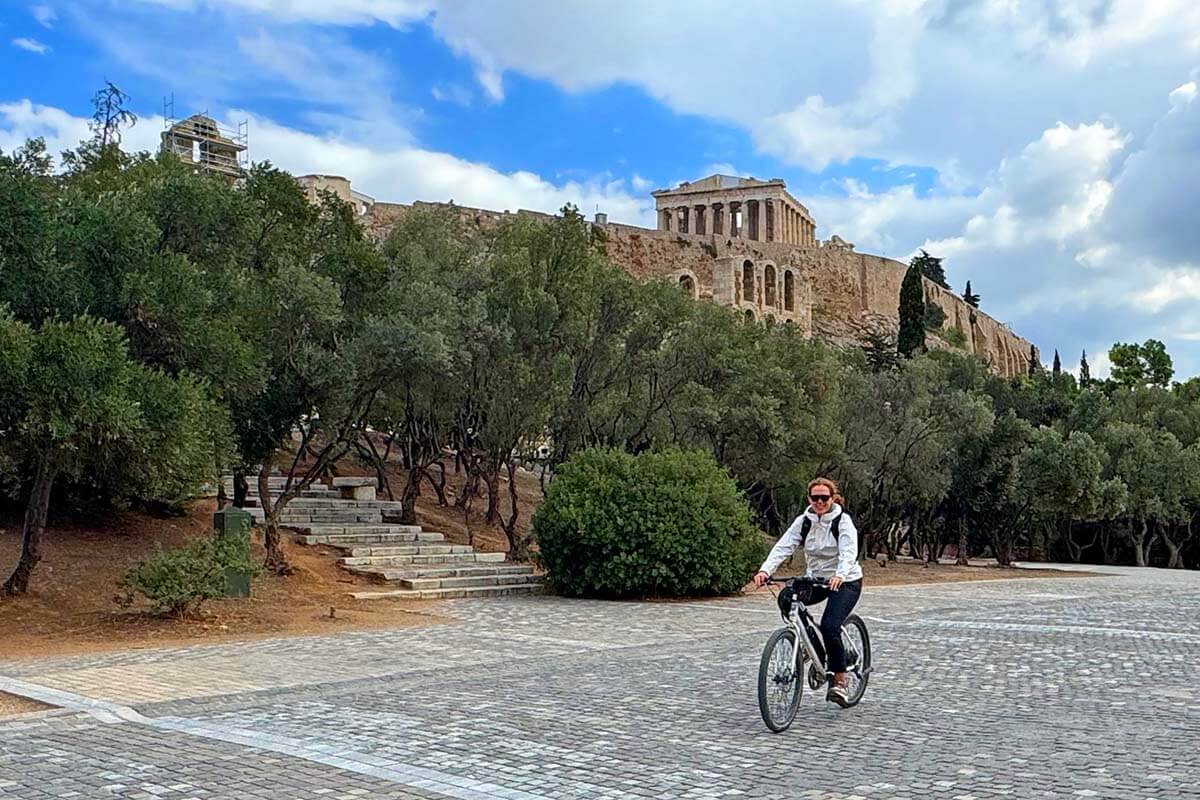
A bike tour is a great way to get your bearings in Athens and see many of the main sights in just a few hours. It also makes it easier to cover places that are farther apart without spending half your day walking between them.
We took this small-group electric bike tour, and it was one of our favorite experiences in Athens. We particularly enjoyed the views from Pnyx and watching the Changing of the Guard ceremony. You can read more about both further below.
We also stopped outside the Panathenaic Stadium, which somehow hadn’t even been on my must-do list. Seeing it and hearing more about it changed my mind, so we came back later for a proper visit. It ended up being one of my favorite places in Athens!
TIP: Book a bike tour early in your trip, maybe even as your first activity. It’s a useful introduction to the city and can help you decide which places you’d like to return to and explore in more detail. And if your time in Athens is limited, it’s one of the best ways to make the most of a short visit.
Time needed: About 3 hours.
Our take: A bike tour is a great way to see a lot in a short time and discover places you might otherwise overlook. For us, it also helped shape the rest of our sightseeing. It’s also a fun activity to do if you’re visiting Athens with teenagers.
4. Panathenaic Stadium
The Panathenaic Stadium was one of our favorite places in Athens. Beautifully restored in white marble and still used for events today, it gives you a much better sense of its original appearance than many of the city’s ancient landmarks. Standing inside, it’s easy to imagine the stands packed with spectators cheering on the athletes below.
The stadium’s history goes back to the 4th century BC, when it was built for the Panathenaic Games, a festival honoring the goddess Athena. It was later rebuilt in marble during Roman times and restored again to host the first modern Olympic Games in 1896.
As mentioned above, we first stopped here on our bike tour. It hadn’t been on my must-do list, but that brief introduction convinced us to return. I’m so glad we did, because visiting inside was a completely different experience from seeing it through the gates.
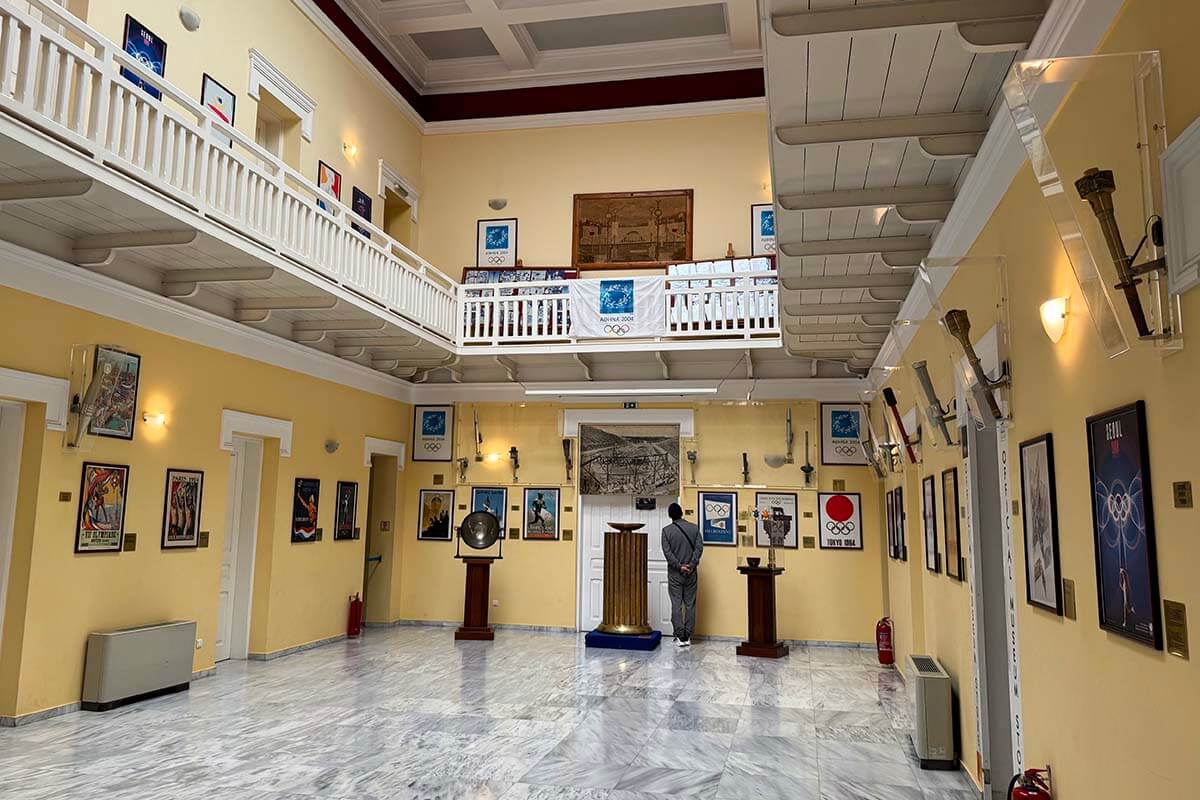
You can walk around the stadium, climb the marble stands for different views, and even run on the track. It’s a fun opportunity to try an Olympic venue for yourself, and lots of visitors were doing exactly that when we visited. Be sure to follow the tunnel to the small exhibition of Olympic posters and torches. It’s a nice addition to the visit, although we had expected a bigger collection.
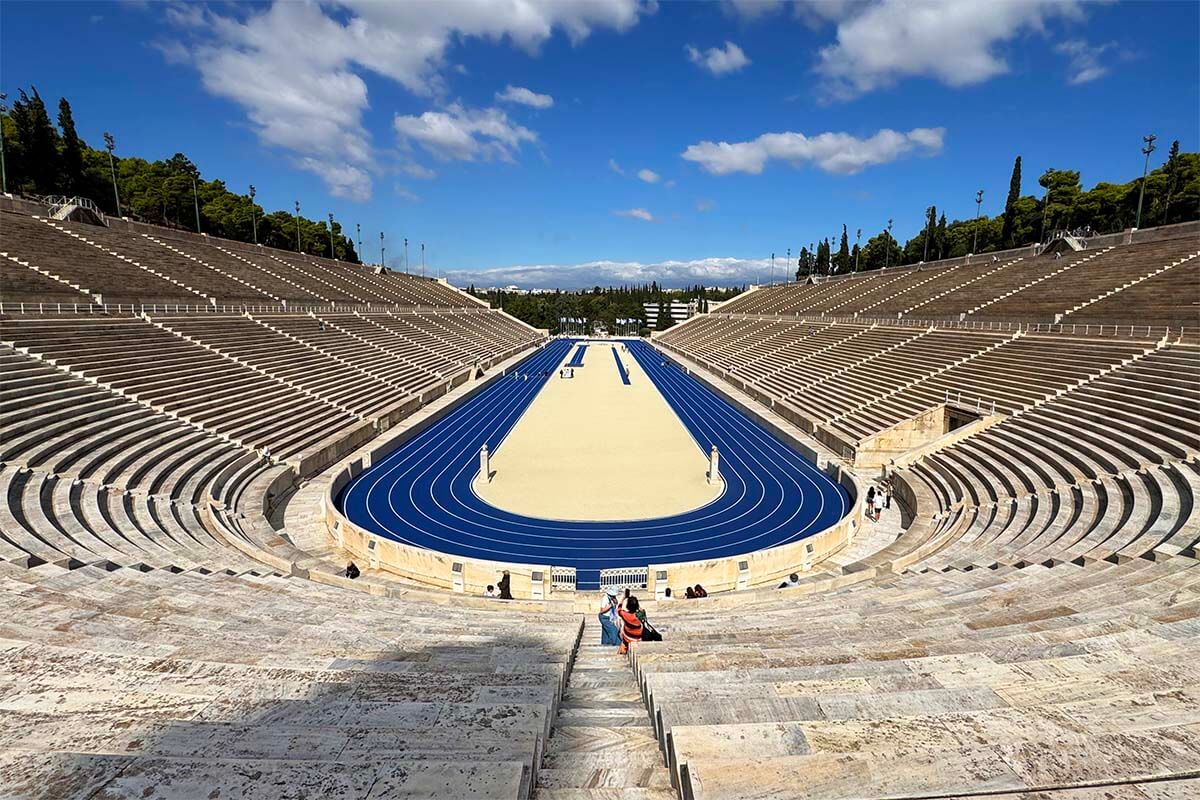
Fun fact: The blue track you see inside the stadium today is about 185 meters long—equivalent to one ancient Greek stade. This unit of measurement was used for footraces and gave us the word “stadium.”
Good to know: We bought our tickets at the entrance, but you can also book online in advance. This could save you some time at the ticket office, especially during peak season.
TIP: Download the Panathenaic Stadium app or pick up an audio guide at the entrance. The commentary is well worth listening to and helps you appreciate the history behind what you’re seeing.
Time needed: About 1 hour.
Our take: The Panathenaic Stadium is one of the most unique places to visit in Athens and absolutely worth going inside. This was an unexpected highlight of our trip, and I’d happily make time for it again.
5. Taste Athens on a Food Tour
A food tour was one of the highlights of our trip to Athens. We love food tours and join them whenever we can. They’re a great way to try a bit of everything and get familiar with local specialties without ordering a full meal every time you want to taste something new.
We booked this ‘full meal experience’ food tour, which combines visits to traditional food shops and the central market area with a wide range of Greek tastings. It’s a very good introduction to the food scene, especially at the beginning of your stay, when you still have plenty of time to try your guide’s recommendations.
One couple on our tour had even booked a different food tour for every day of their trip! If that sounds like your kind of vacation, this street food tour looks worth considering alongside the one we did. There’s some overlap, but the different focus could help you discover an even wider variety of Greek food.
That said, most tours I looked at included quite a few similar specialties, so there’s no need to overthink the choice. Pick one that suits your interests and itinerary, ideally at the beginning of your trip, and ask your guide which other dishes and places they recommend trying afterward.

Good to know: Athens Central Market is closed on Sundays. If you want to visit the market, book a tour on another day. For a Sunday food tour, look for an itinerary that doesn’t depend on a market visit, such as the street food tour mentioned above or this evening food tour.
TIP: Come hungry and don’t plan a big meal afterward. Comfortable shoes are a good idea, too, since you’ll be walking between stops.
Time needed: About 4 hours for the tour we took; other options vary from 2 to 4 hours. You can find a wide selection of Athens food tours here.
Our take: Definitely worth doing and one of our favorite experiences in Athens. Book it early in your stay so you can put all those food tips to good use!

6. Plaka & Athens’ Historic Neighborhoods
Exploring Athens’ historic neighborhoods is a big part of visiting the city, but you don’t necessarily need to set aside extra time for most of them. The central areas are close together, and if you stay for a few days, you’ll see a lot simply by walking between the main sights. Our bike and food tours took us through some of these areas, too.
Our take: Some areas, especially Anafiotika and Psyrri, are easy to miss if you only follow the most direct routes between major landmarks. Even in the popular neighborhoods, it’s easy to end up walking the same streets again and again. So make an effort to take a few detours into smaller streets, too. You’ll get a much better feel for the city.
Here are some of the nicest areas to visit in Athens:
Plaka
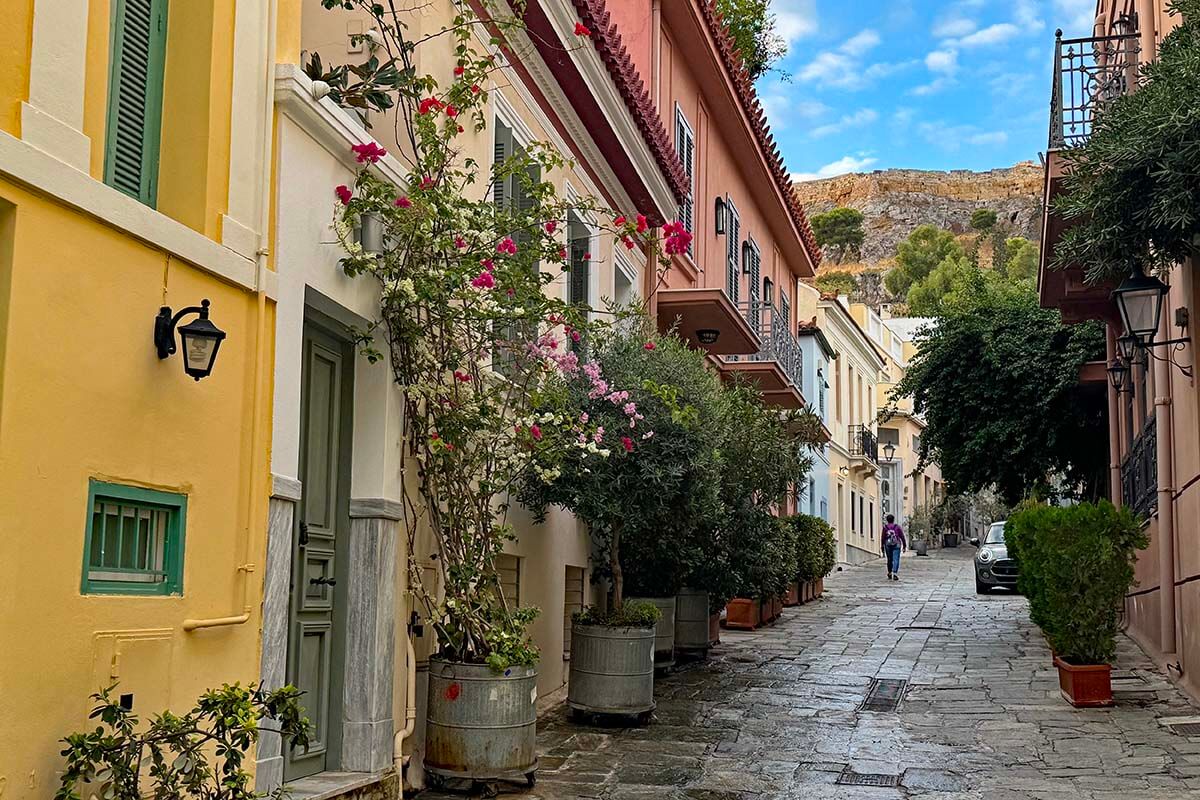
Plaka is one of the best-known neighborhoods in Athens, with narrow streets, colorful buildings, shops, cafés, and tavernas. It’s very touristy, but it’s also a lovely area to explore on foot, with some good restaurants serving regional Greek specialties.
Don’t miss Tripodon Street, considered the oldest street in Athens. Much of it follows the ancient road, and it has kept the same name for nearly 2,500 years. The small Byzantine Church of St. Nicholas Ragavas is another worthwhile stop while exploring the neighborhood.
You’ll likely walk through Plaka several times during your stay. Take a different route when you can, and head up toward the restaurant-lined steps and smaller streets closer to the Acropolis.
Anafiotika
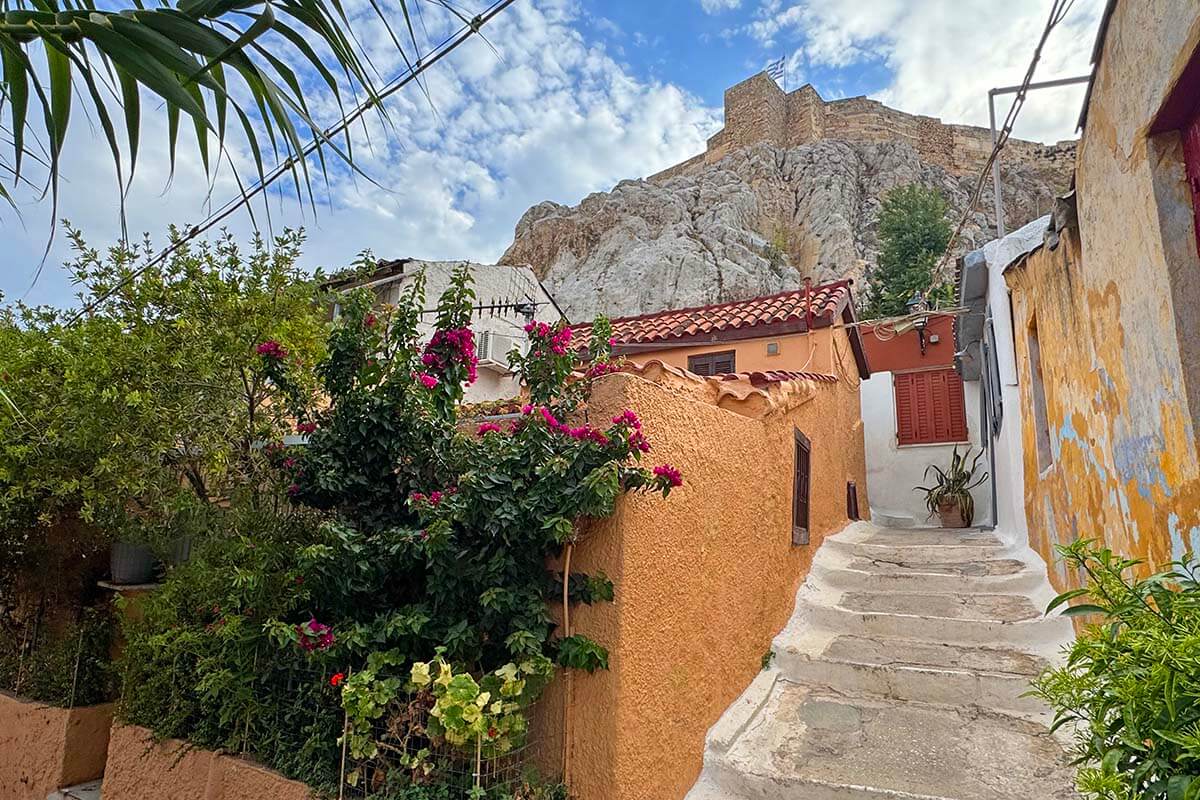
Anafiotika is a small neighborhood on the hillside above Plaka and below the Acropolis. Expect tiny houses, narrow passages, and lots of stairs. Some houses are nicely renovated, while others look run-down or abandoned. As you explore, you’ll also spot interesting street art and plenty of cats.
This is one of the best places where you can get a feel for what Athens must have looked like in the past. It’s very different from any other part of the city and incomparably quieter than the busy streets below.
Anafiotika is easy to combine with the Acropolis or the ancient sites around Plaka. That said, you won’t pass here by chance, so put it on your map and plan a short detour (20-30 minutes should be plenty). Also keep in mind that people live here, so explore quietly and respect private entrances.
Ermou Street & the Churches
Ermou Street is one of Athens’ main shopping streets, linking Syntagma Square with Monastiraki. Right in the middle of the pedestrian shopping area, you’ll find the small Byzantine Kapnikarea Church, surrounded by modern stores.
A short detour brings you to Athens Cathedral on Mitropoleos Square. For the fans, the Maria Callas Museum is also located nearby. All are easy stops to include while walking through the center.

Monastiraki Square
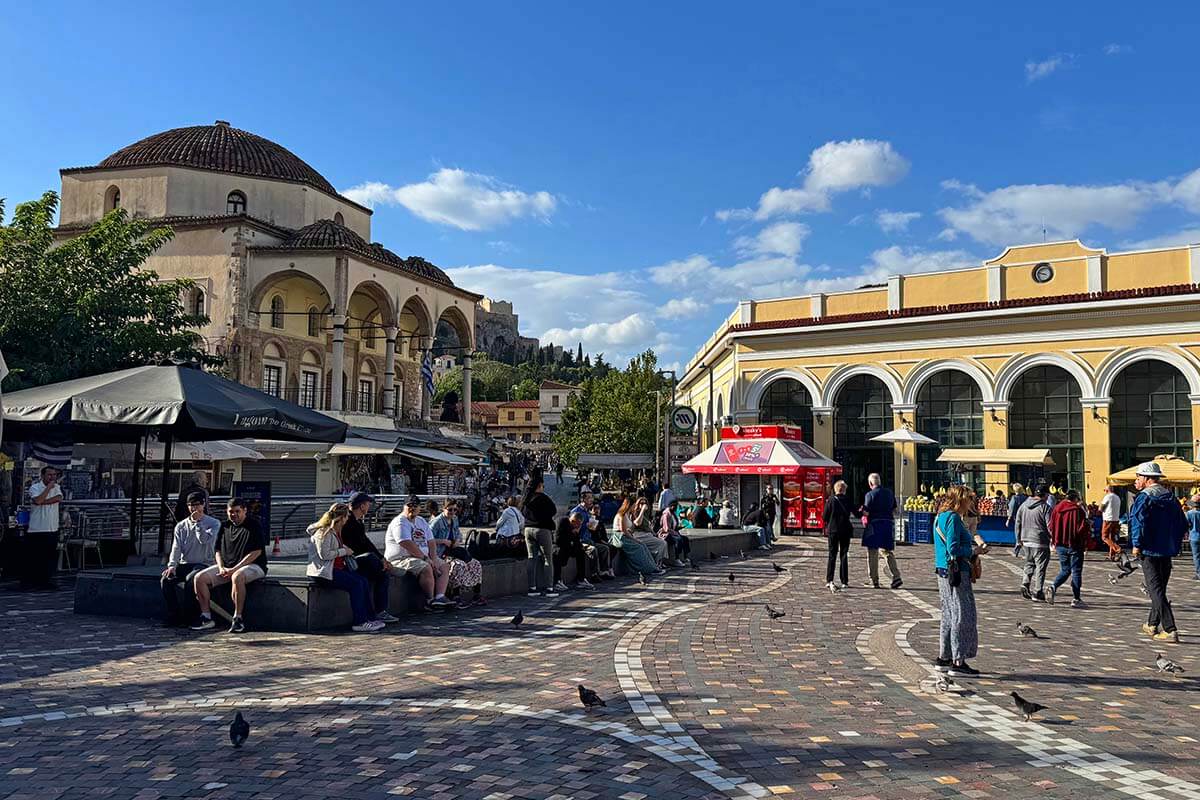
Monastiraki Square is one of the busiest spots in central Athens, with views of the Acropolis, historic buildings, and shopping streets leading off in several directions. Between Plaka, Psyri, and the Ancient Agora, you’ll likely pass here more than once.
The nearby Monastiraki Flea Market is mostly a network of small shops selling souvenirs, clothes, sandals, and accessories, rather than a traditional open-air flea market, but it’s fun to walk through. If you are looking for antiques, secondhand items, and more unusual finds, explore farther along the side streets toward Abyssinia Square.
Psyri
Psyri, also spelled Psyrri or Psirri, is just a short walk from Monastiraki, but easy to miss if you stick to the main sightseeing routes. Centered around Iroon Square, it’s a lively neighborhood with interesting street art, small shops, cafés, bars, and plenty of places to eat.
In the evenings, several tavernas host live Greek music, making this a great lively area for dinner.
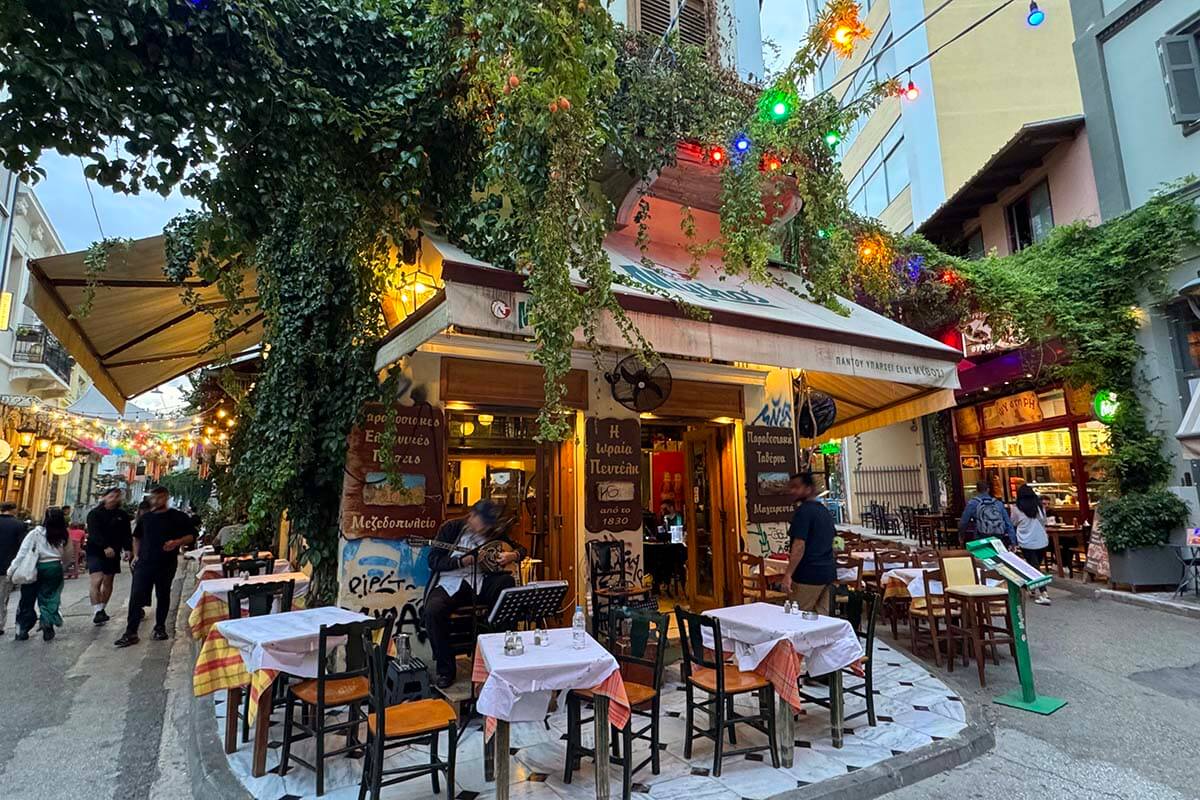
One of Athens’ most photographed cafés, Little Kook, is also located in Psyri. It’s more than a single café, with themed shops and elaborate decorations spread along the street. The elaborate decor changes with the seasons, and it’s worth a short detour even if you don’t stop for anything to eat.
We visited in October, when the whole area was filled with Halloween decorations and the menu included desserts such as coffin-shaped chocolate cake. They also have a year-round Christmas shop.
We passed Little Kook several times, including on our food tour, and our guide told us it’s very popular with locals, too.

Pedestrian Streets Around the Acropolis
For a walk with views of the Acropolis, follow Dionysiou Areopagitou and Apostolou Pavlou, the pedestrian streets along its southern and western sides. They connect the area around the Acropolis Museum with Thissio and the Ancient Agora, so it’s easy to include this route while sightseeing.
Our bike tour passed here, but otherwise it’s well worth exploring on foot to enjoy the views or stop for a drink.
7. Ancient Agora
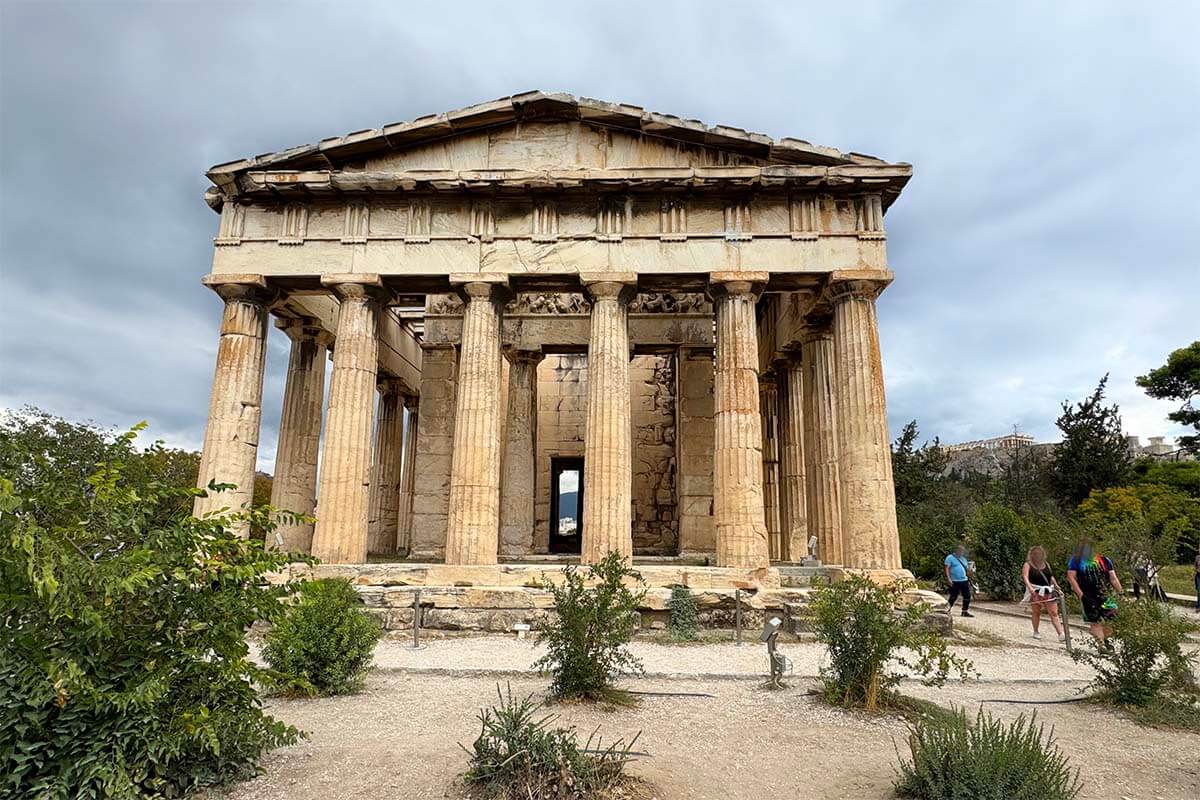
The Ancient Agora is one of the most interesting ancient sites in Athens. During the Classical period, particularly in the 5th and 4th centuries BC, this was the center of public life, where people came to trade, discuss politics, and do business. Today, it’s a ticketed archaeological site, like an open-air museum.
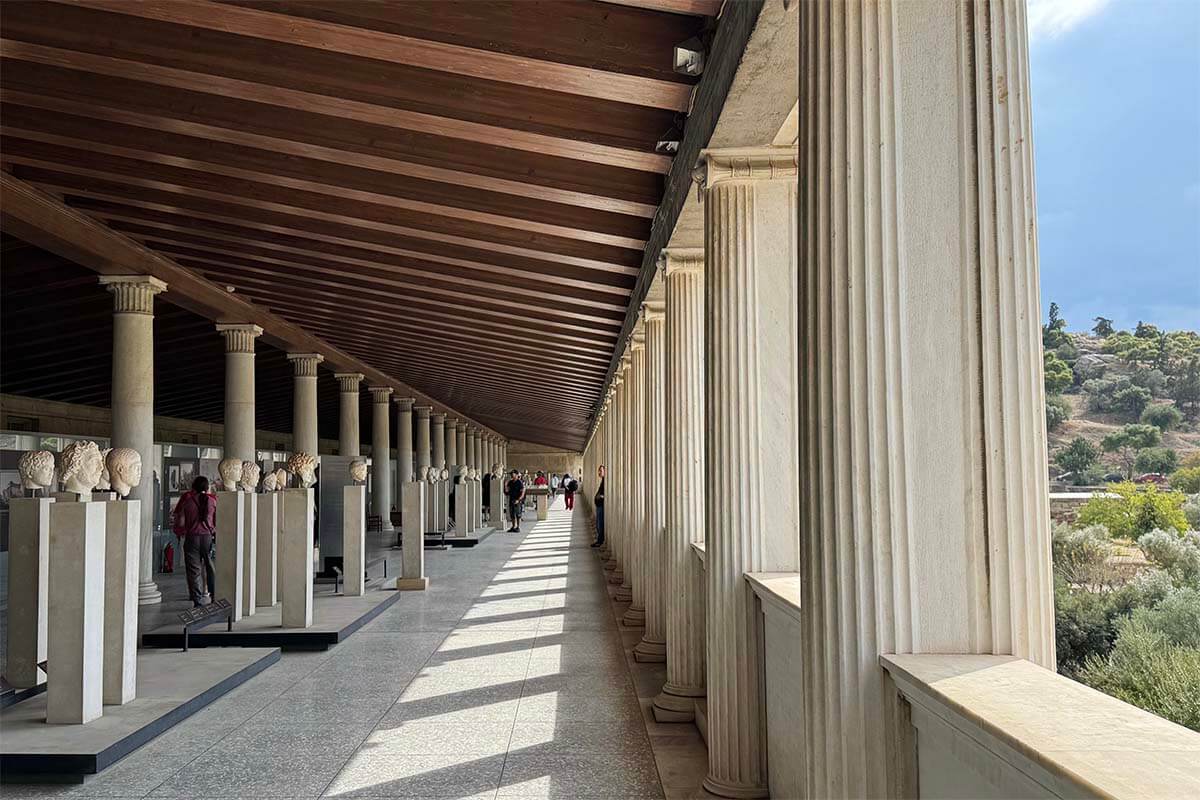
Most of this vast site consists of foundations and scattered ruins, but there are two main landmarks you shouldn’t miss: the Temple of Hephaestus, one of the best-preserved ancient Greek temples, and the Stoa of Attalos, a reconstructed ancient building with a long, covered colonnade. Nowadays, it houses the Agora of Athens Museum.
Also look out for the 10th-century Church of the Holy Apostles and the modern Socrates and Confucius sculpture, unveiled in 2021 to symbolize a dialogue between Western and Eastern philosophy.
Good to know: Don’t confuse the Ancient Agora with the nearby Roman Agora – they are separate sites, requiring separate tickets.
TIP: Buying tickets online can save you time at the ticket office. We actually bought ours on our phones while standing in line and skipped most of the queue.
Time needed: About 1.5–2 hours.
Our take: The Ancient Agora felt like the best place to get a sense of what Athens must have looked like in ancient times, so it’s definitely worth a visit. If you’re short on time, prioritize the Temple of Hephaestus and the Stoa of Attalos. If you have longer and it’s not too hot, the rest of this vast site is well worth exploring, too.
8. Changing of the Guard
The Changing of the Guard is one of the most unusual things to see in Athens, and it’s completely free. The guards, known as Evzones, wear traditional uniforms and stand almost completely motionless. Once per hour, they perform a carefully synchronized routine with very distinctive movements and high steps that made us think of John Cleese’s Ministry of Silly Walks. All joking aside, the precision and discipline involved are beyond impressive.
You can watch the ceremony at two main locations (see also our map):
- Syntagma Square: At the Tomb of the Unknown Soldier, in front of the Greek Parliament. The guards change every hour, on the hour, throughout the day and night.
- Presidential Mansion: On Irodou Attikou Street, beside the National Garden. The guards change hourly, usually at 20 minutes past the hour. There are fewer spectators here, and you can usually get closer to the guards. We watched the ceremony here during our bike tour; they timed it perfectly.
Time needed: Allow about 15–20 minutes for an hourly ceremony, including arriving a few minutes early.
Good to know: On Sundays at 11 AM, a larger ceremony takes place at Syntagma Square, with a procession of Evzones accompanied by a military band. It draws a huge crowd, but arriving early doesn’t necessarily guarantee the best view.

Our experience: We saw both the Sunday ceremony in front of the Parliament and the regular ceremony at the Presidential Mansion. We enjoyed the latter much more. It was quieter, there was some shade, and we could get a good view even though we arrived just minutes before it started.
On Sunday, we arrived 45 minutes early, and even in October, the central viewing area was already packed. We stood near the northern guard booth, thinking we’d missed the best spots. However, before the ceremony, they cleared the square and moved the crowd across the main road. By sheer luck, we ended up in the front row behind the ropes, close to the guards.
Unless you’re near the front, you’ll likely see the changing itself much better during a regular hourly ceremony. Waiting around with no shade can also get uncomfortable, so bring a sun hat and drinking water. It was hot enough in October; I can only imagine what it’s like in summer!
Our take: A must-do in Athens, but don’t worry if you miss the Sunday ceremony. We preferred the quieter hourly change at the Presidential Mansion, where we could stand closer and get a much better look at the movements, uniforms, and smaller details.

9. Rooftop Drinks & Dining with Acropolis Views
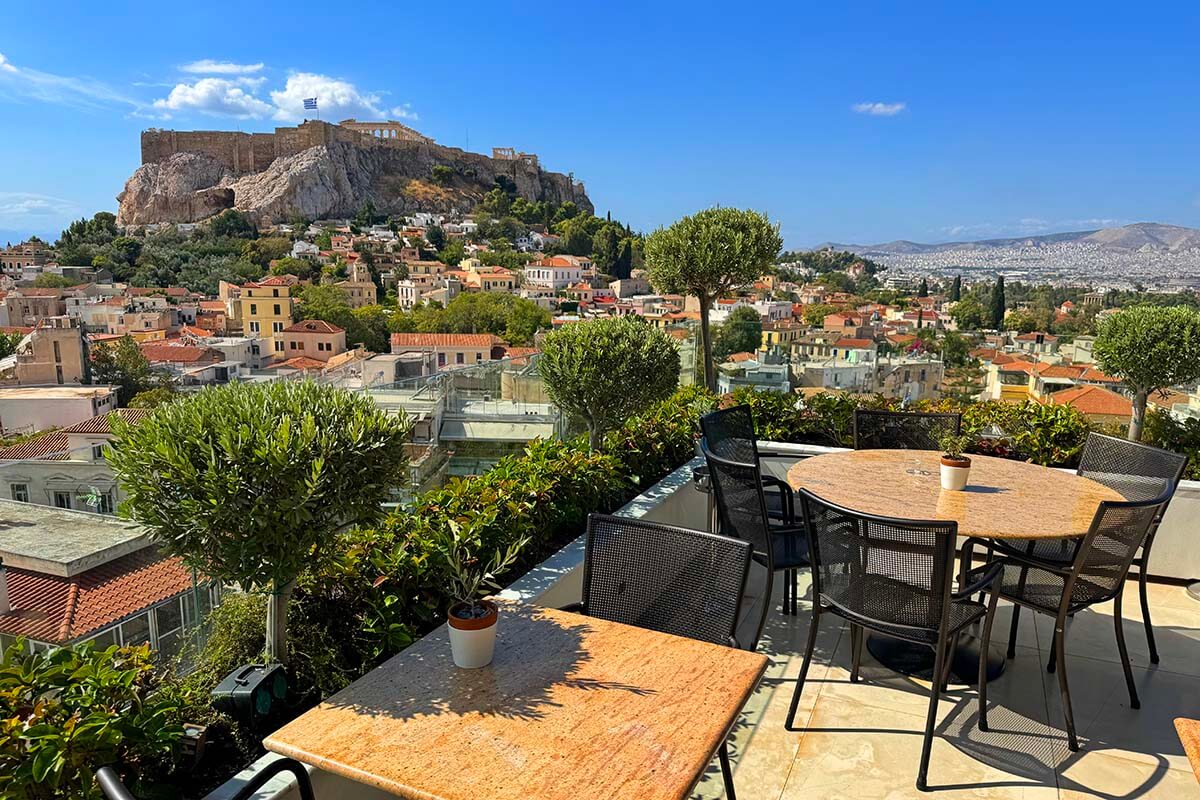
Having drinks or a meal with a view of the Acropolis is one of the experiences I wouldn’t miss in Athens. There are so many rooftop bars and restaurants that you could try a different one every day, or a few each day. We visited several and enjoyed them all for different reasons.
Here are some of the places we tried:
- Electra Roof Garden at Electra Palace. A luxurious setting with amazing Acropolis views and great food. We came for lunch, and this would be my pick for a more upscale meal or a special occasion. You can also visit just for drinks.
- Elysium Athens Rooftop. Another great option for Acropolis views, but ask for a table at the front of the terrace. The views from inside are less impressive, and some seating areas have no view at all.
- Anglais Athens. One of our guides recommended this as a local favorite, and we really enjoyed it for cocktails and direct views of the Acropolis. It was wonderfully quiet when we arrived, especially compared with the busy rooftops around nearby Monastiraki Square.
- Fresh Hotel rooftop. We stayed at this hotel and loved having a rooftop pool and bar to return to after sightseeing. The Acropolis is much farther away, though, so it’s nice to do if staying here, but I wouldn’t make a special trip. Nearby Olympias Rooftop Bar offers better views in this area.
Other popular choices include 360 Cocktail Bar, Attic Urban Rooftop, Couleur Locale, MS, and A for Athens, to mention just a few. These are very central and can get very busy, especially around sunset.
TIP: If you’re going for sunset drinks or dinner, book ahead and ask for a table with an unobstructed Acropolis view. Alternatively, visit for lunch or a drink during quieter hours.
Staying at a hotel with a rooftop terrace or pool is another great way to enjoy the views. We stayed at Fresh Hotel, a modern design hotel near the central market, with a rooftop restaurant, bar, and pool. For a more luxurious stay, I recommend Electra Palace, with its wonderful rooftop restaurant and pool overlooking the Acropolis. Its location in Plaka is another big plus, with many of Athens’ main sights within walking distance.
Our take: Try a few different rooftops if your itinerary allows. It doesn’t have to be a fancy dinner: lunch or a drink with an Acropolis view is just as enjoyable. And if you can, choose a hotel with a nice rooftop. We loved having somewhere to relax above the city after sightseeing.
10. Mount Lycabettus
Mount Lycabettus, the highest hill in central Athens, is one of the most popular places to visit at sunset. It offers wide-ranging views over the city, the Acropolis, and the sea in the distance. At the summit, you’ll find the small white Chapel of St. George and a restaurant.
There are several ways to get here:
- Walk up. Paths approach the summit from different sides. We came from the National Archaeological Museum and climbed from the “wilder” northern side. After the visit, we walked down toward Kolonaki, on the south side where the funicular is located. The southern route was much better, both for the path itself and the views along the way. If walking, I’d choose that side in both directions.
- Take the funicular. It leaves from the corner of Aristippou and Ploutarchou Streets in Kolonaki. The ride is short and runs entirely through a tunnel, so you won’t see any views until you get out. Keep in mind that reaching the lower station on foot still involves an uphill walk.
- Take a taxi partway up. A taxi can take you to the upper parking area near Lycabettus Theatre, but you’ll still need to walk uphill to the summit. It can be cheaper than the funicular, especially if there are several of you.
We visited at sunset, and while the views were beautiful, the summit was far too crowded to enjoy properly. The viewing area around the chapel is really small, and there simply wasn’t enough room for everyone.
TIP: I’d avoid sunset at the summit. If you want to watch the sunset, find a spot farther down the walking path on the Kolonaki side, where it’s much quieter and you can still enjoy the views. Otherwise, visit earlier in the day and take your time exploring.
Time needed: About 1 hour, depending on how you get up and down, plus travel time from the historic center.
Our take: I’m glad we went, but the crowds took away from the experience. The views along the path were more enjoyable than squeezing into the small area at the top, so don’t feel you have to reach/stay at the summit to make the visit worthwhile.

11. Roman Agora & More Ancient Sites Around the City
Beyond the Acropolis and Ancient Agora, you’ll come across many other ancient sites in Athens. We passed several on our bike tour and while walking around the city. It’s worth pausing to look, but you don’t necessarily need to buy a ticket for every one.
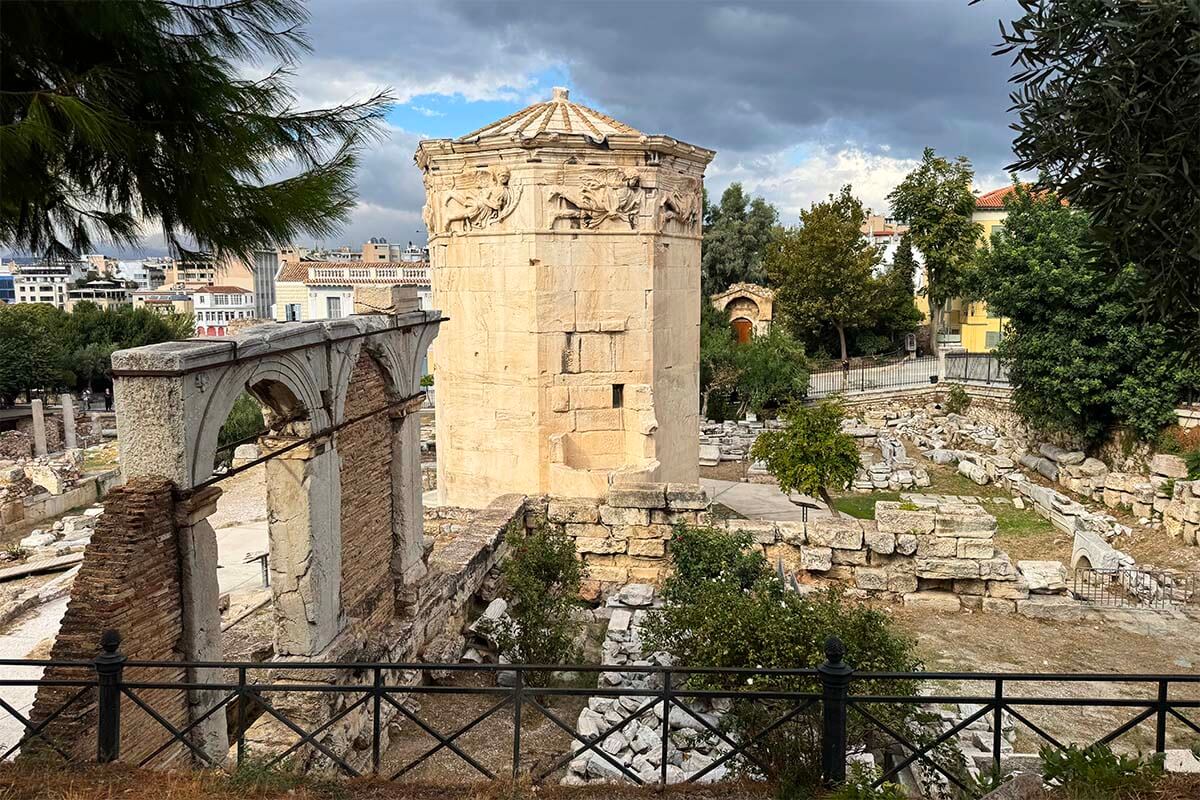
The Roman Agora, near Monastiraki and Plaka, was a marketplace in Roman times. Look out for the Tower of the Winds, an eight-sided marble building that served as an ancient timepiece and weather vane. You can see much of the site through the surrounding railings.
Nearby, Hadrian’s Library once housed a collection of scrolls, with reading rooms and a large courtyard. Today, only parts of the complex remain, including an impressive row of columns visible from outside.
The Temple of Olympian Zeus gives you a sense of its enormous scale, even with only a few columns still standing today. Right beside it, Hadrian’s Arch is easy to see up close without a ticket and makes a quick stop while walking through this part of the city.
Time needed: A few minutes at each site to look from the outside, easily worked into your sightseeing around the center.
Our take: With separate admission fees adding up, we didn’t feel it was worth paying to enter every ancient site. Unless you have a particular interest in one of them, seeing these from the outside gives you a good impression. For us, the Acropolis and Ancient Agora were the two ancient sites most worth paying to visit.
12. Try Greek Specialties & Traditional Tavernas
Eating is one of the best things to do in Athens, and there’s much more to try than you could fit into a single trip. I had marked so many restaurants, cafés, and bakeries on our map, but even a week wasn’t nearly enough. We simply weren’t hungry enough to eat that often, and the portions are really generous. That’s why we love food tours, where you can try a bit of everything!
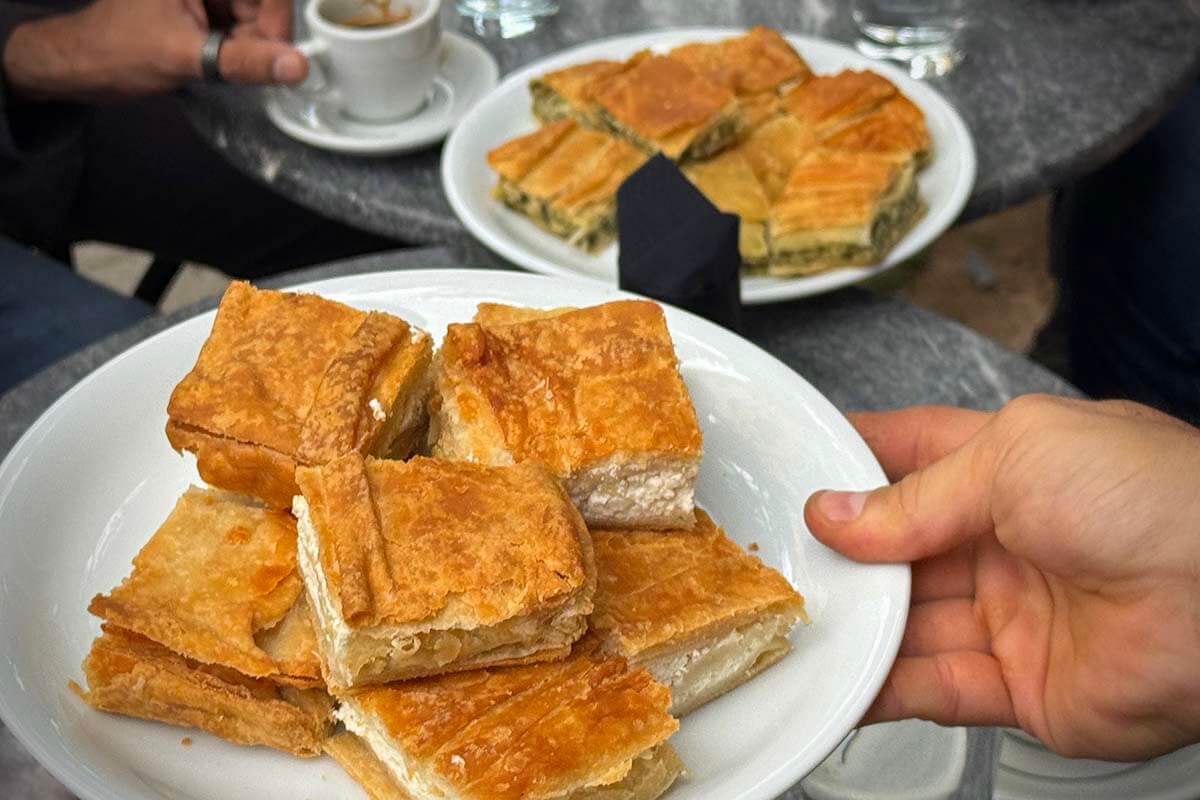
Beyond traditional tavernas, leave room for coffee and bakery stops. Try Greek coffee, savory pies such as spanakopita (spinach pie) and tiropita (cheese pie), and loukoumades, small Greek donuts traditionally served with honey and cinnamon. We tried all of these and much more on our food tour, and the little shops and cafés we visited were among our favorite food stops in Athens.
Below, you can find some restaurant recommendations and observations, based on our experience.
Restaurant Scholarhio in Plaka offered a sharing menu that let us try several specialties, including dishes from Crete. It was a great way to taste a bit of everything, but the portions were huge. Our two-person menu felt like enough food for three, or even a family of four with younger children.
MIRONI Restaurant was another favorite. It’s a little away from the main sightseeing areas, but conveniently near where our Cape Sounion tour ended. We loved the food, there was live music, and we got a table without much of a wait.

Karamanlidika, near our hotel and the central market, was another place we enjoyed. Its menu includes cured meats, cheeses, and small dishes to share.
Taverna Klimataria, known for its live music evenings, serves the kind of traditional, home-style food you might hope to find at a Greek grandma’s table. We originally booked for an evening with music, but it wasn’t due to start until 9:30 PM, and we were too exhausted to wait that long. So we canceled that reservation and ate much earlier. Honestly, while the food was good, we found the restaurant a bit overhyped. It’s nice to try if you can get a table, but I wouldn’t go out of my way for it.
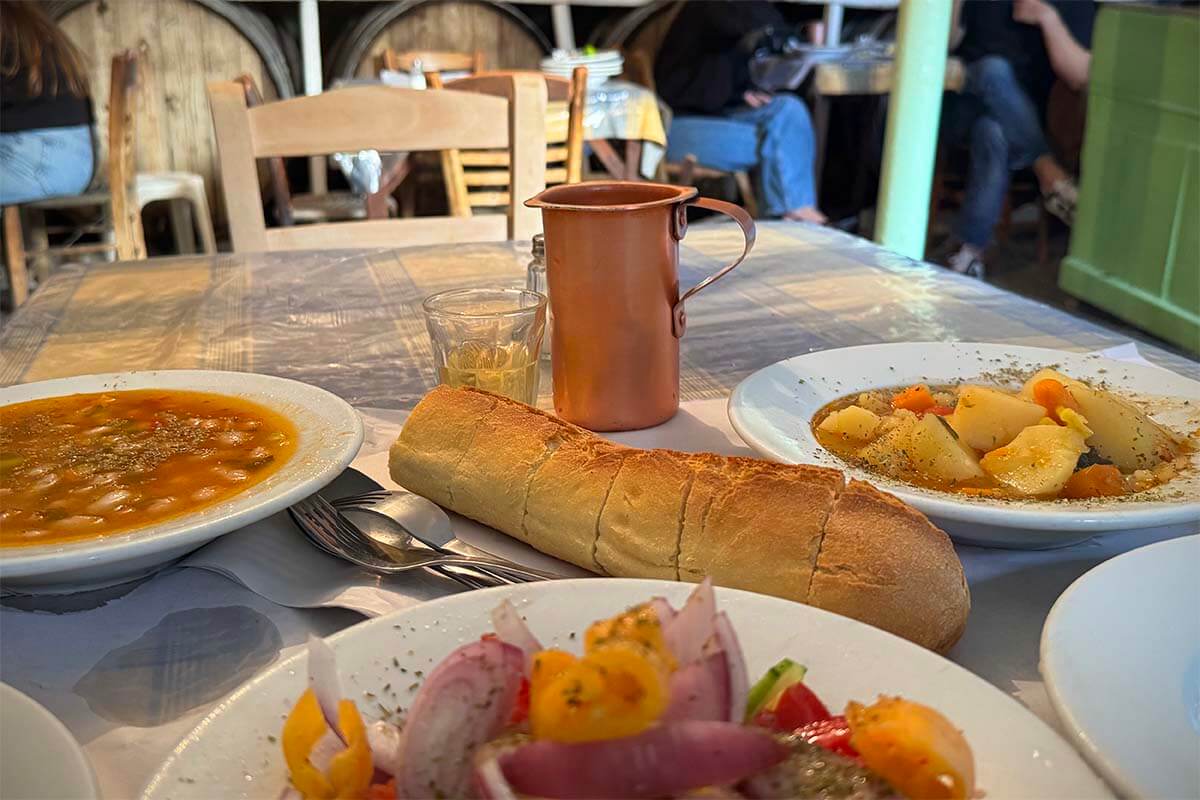
For something very different, Diporto is an old basement taverna near the market, with two entrances (hence the name) where steps lead down through openings in the sidewalk. It’s easy to miss, especially when the doors are closed. We found it by chance, only later realizing how well-known it had become online. You eat what’s been cooked that day; our meal included salad, bean soup, sardines, bread, and wine. The food was fine, but we ate better almost everywhere else, so if you go here, it’s mostly for the unusual setting.
We also tried LUKUMADES, where we ordered donuts with honey and cinnamon. It and the neighboring Tylixto gyros shop are apparently very popular on social media and had huge queues whenever we passed. The donuts were good, but those on our food tour were just as tasty without the long wait. Our tour also included fantastic gyros that we could enjoy sitting comfortably at a table, so we skipped the line at Tylixto.
Good to know: Greek people tend to eat dinner really late, usually past 9 PM, and live music often starts even later. So if you’re booking a taverna specifically for live music, check when it starts and consider whether it fits into your schedule. Otherwise, just go for an early dinner – it will be much easier to get a table, even at the most popular restaurants.
Time needed: About 1–2 hours for a sit-down meal, or a quick stop for coffee, pastries, or street food.
Our take: Save a few places on your map, but leave room for spontaneous stops. We didn’t have a single bad meal in Athens, and some of our favorites required very little planning. With so many good options, I wouldn’t spend precious sightseeing time waiting in line just because a place is famous online.
13. Acropolis Views from Pnyx & Philopappos Hill
For some of the best Acropolis views, head to Pnyx, a hill across the pedestrian promenade from the Acropolis. We visited here on this e-bike tour, and the views were amazing. Of all the Acropolis views we enjoyed across Athens, this was our favorite, with the entire hill and its ancient buildings in full view.
Pnyx is also worth visiting for its history. This was a meeting place of the ancient Athenian assembly, where citizens gathered to debate and vote. You can still see the stone speakers’ platform overlooking the assembly area.
We explored the Pnyx area near the National Observatory. If you have more time, paths connect it to Philopappos Hill, topped by a Roman-era monument, with more viewpoints along the way. You don’t need to follow a particular route to enjoy this area, but marking the Pnyx and Philopappos Monuments on your map will help you find your bearings.
Good to know: Although these hills are close to the Acropolis, exploring the wider area adds quite a bit of uphill walking to your day. We were glad to have electric bikes, especially with so much other walking already on our itinerary.
Time needed: Allow about 15–20 minutes for Pnyx and its views, or 1–1.5 hours for a longer walk including Philopappos Hill, plus time to get here.
Our take: Really worth seeing for the views (although I wish I had packed my camera and not just a smartphone). But I’m glad we visited by e-bike and on a cooler day. I wouldn’t want to explore here on foot in the summer heat.
14. Athens Central Market
Athens Central Market, also known as the Varvakios Market, offers a glimpse of everyday food shopping in the city. The covered halls sell meat and seafood, while nearby shops and stalls sell everything from olives and spices to nuts and dried fruit.
Many food tours include a walk through the market, but it’s also easy to stop by independently. Our hotel was just nearby, so we passed through several times and even stopped on our way to the airport to buy some delicious nuts to take home.
Good to know: The meat and seafood sections can be quite confronting, both for the sights and the smells. Expect whole animals hanging from hooks, pigs’ heads and feet, sheep’s heads, and organs on display. This is one of the most real food markets I’ve ever seen, and we’ve visited our fair share of quirky markets around the world.
If you have a weak stomach, skip the meat section and head to the fruit, vegetable, and olive stalls across Athinas Street, or browse the nuts and spices along the main road.
Good to know: Visit in the morning to see the market in full swing. Keep in mind that the market is closed on Sundays.
Time needed: About 10–20 minutes, longer if you stop to shop.
Our take: Absolutely worth a short visit, with a food tour or on your own. There are also several good local cafés and restaurants in the market area if you’d like to put together your own food tour.

15. National Garden
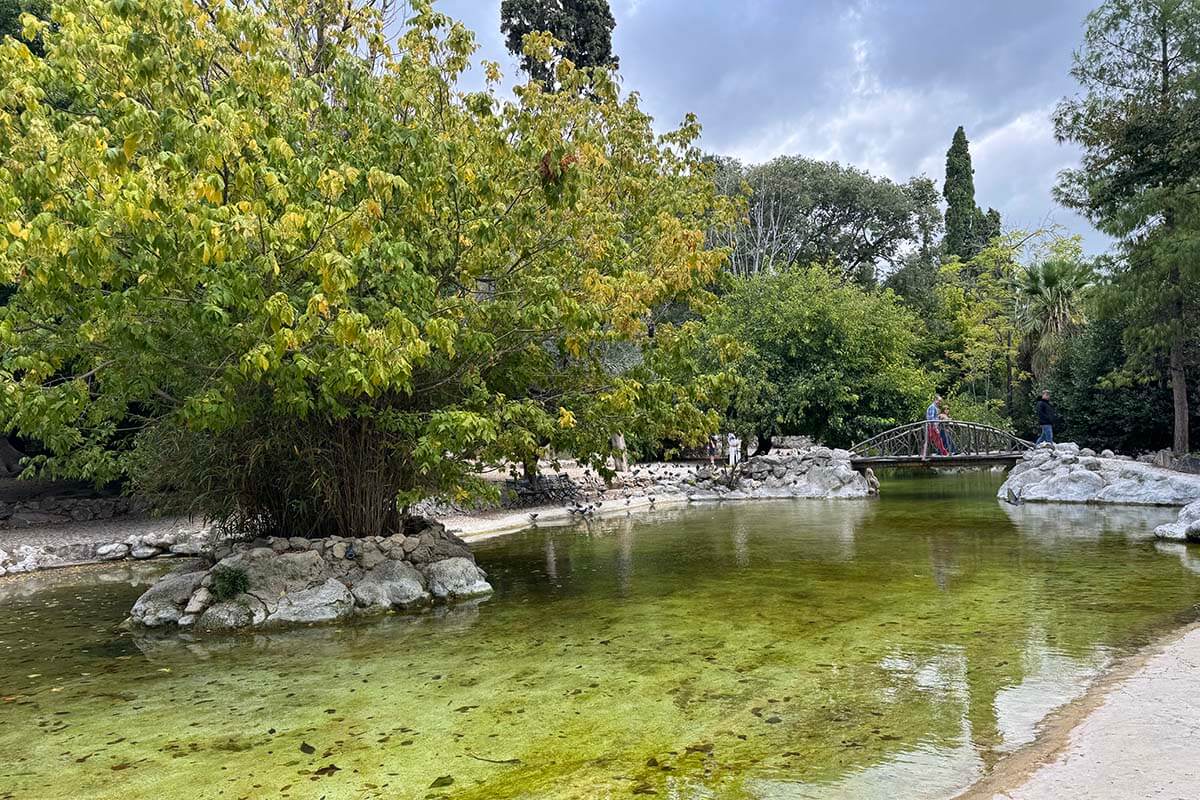
The National Garden, beside Syntagma Square and the Greek Parliament, is a lovely place for a break from the busy streets. Originally created as a royal garden, it has shady paths, tall palms, ponds, and benches where you can rest between sightseeing stops.
TIP: Look out for the ancient Roman mosaic floor in the northern part of the garden, and don’t miss Zappeion Hall, the grand neoclassical building at the southern end of the wider park grounds.
We passed through on our bike tour and returned on foot, walking from the Changing of the Guard ceremony to the Panathenaic Stadium. It was a welcome change from the traffic and crowds, and the shade alone made it worth taking the route through the gardens.
Time needed: About 30–60 minutes for a proper visit, or simply walk through between other sights.
Our take: You don’t need to plan a separate visit here, but it’s well worth walking through when sightseeing in this part of Athens. Leave a little extra time to sit down and enjoy the shade, especially on a hot day.
16. National Archaeological Museum
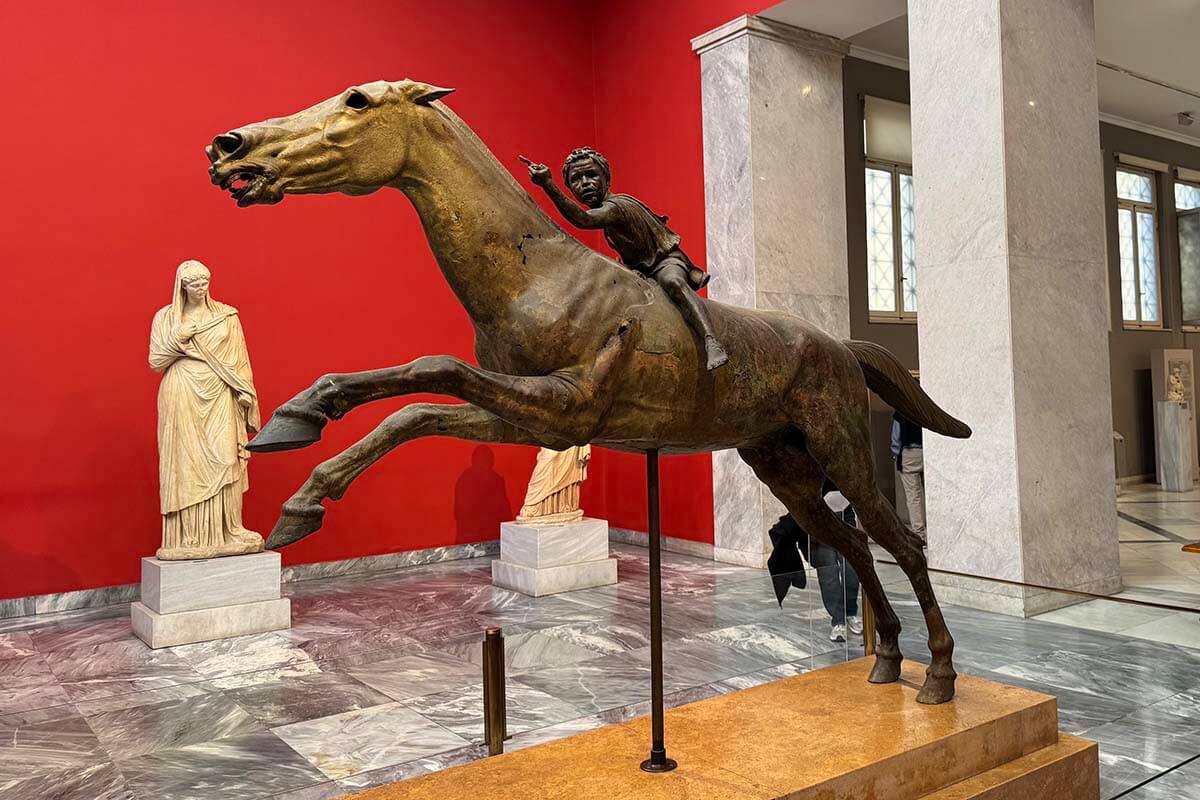
The National Archaeological Museum has a huge collection of ancient finds from across Greece, including sculptures, pottery, jewelry, and treasures from Mycenae. It covers a much broader history than the Acropolis Museum, so there’s plenty to see even if you’ve already visited that one.
The main highlight is the Antikythera Mechanism (150–87 BC), an ancient device used to calculate astronomical cycles. Also look out for the large bronze statue of Zeus or Poseidon and the Jockey of Artemision (150–140 BC), a striking sculpture of a young rider on a galloping horse. You’ll also find Cycladic figurines and colorful wall paintings from ancient Santorini.
Time needed: About 1.5–2 hours for the highlights, longer if you have a particular interest in ancient history.
Our take: Nice to see, but it didn’t impress us that much personally. It’s a good option if you have extra time or want to spend a few hours indoors away from the heat. On a short visit, we’d prioritize the other places and experiences mentioned in this guide.
17. The Athens Trilogy
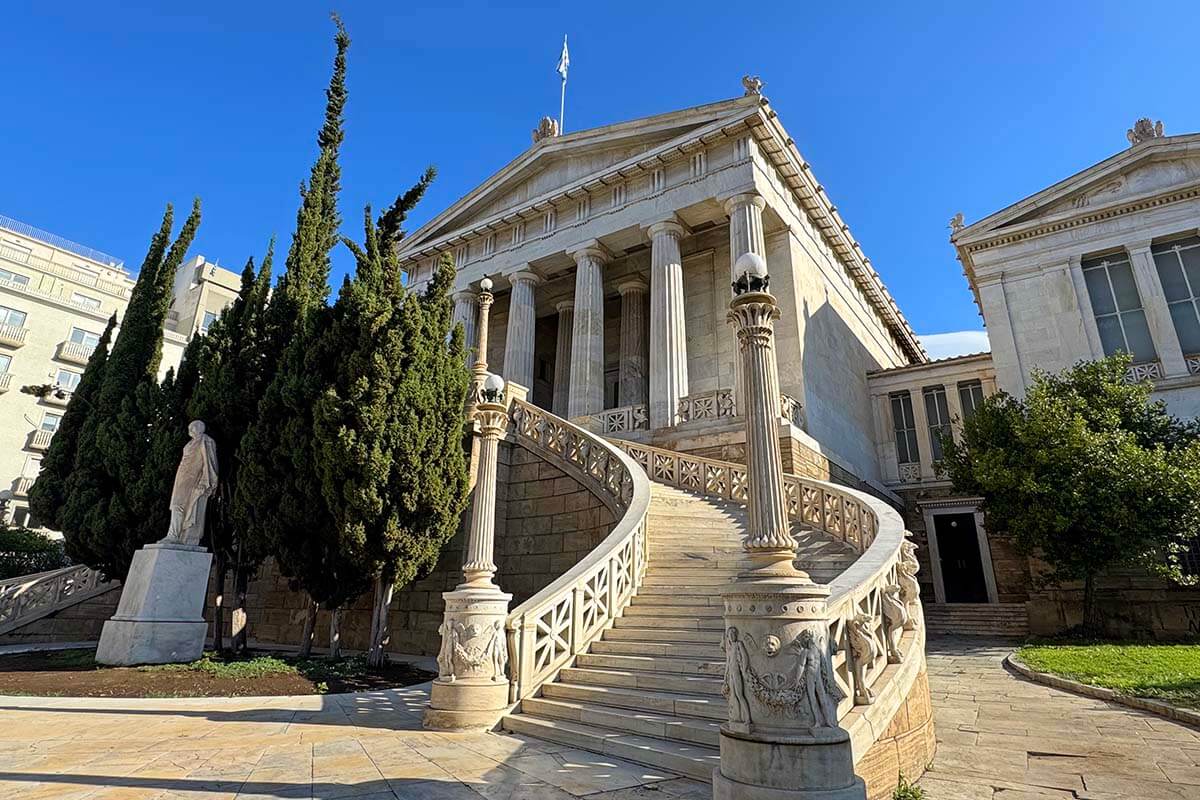
For some of the grandest buildings in Athens, take a short detour along Panepistimiou Street. Here, the Academy of Athens, the historic University of Athens building, and Vallianeio Megaron, the former home of the National Library, stand side by side. Together, they’re known as the Athens Trilogy. Their columns and sculptures draw on ancient Greek architecture, but the buildings themselves belong to modern Athens.
Take a few minutes to look at the details: the Academy’s statues and decorated pediment, the paintings above the University’s entrance, and the grand curved staircases of the old National Library. You can enjoy the architecture from outside, making this an easy stop at any time of day.
Time needed: About 15–20 minutes to see all three from outside.
Our take: Well worth a short detour and easy to combine with the Changing of the Guard ceremony in front of the Parliament.
Our Favorite Day Trips from Athens
Some of our favorite experiences on this trip were outside Athens. We visited Meteora, spent a day on Hydra, and took a sunset trip to Cape Sounion. All three offer something different, but Meteora and Hydra were the highlights for us. Here’s what to expect and what we’d prioritize:
Meteora
Meteora is one of the most unique places to visit in Greece, with centuries-old monasteries built on top of enormous rock pillars. The combination of the landscape and the buildings makes this UNESCO World Heritage Site unlike anything you’ll see in Athens.
It’s a very long drive from the city, so you’ll need a full day. We were worried about whether it was worth it, but we took this organized Meteora tour, and it was so well organized (including breakfast and dinner stops at a really good beachfront restaurant) that we’d do it again without any hesitation.
Our take: For us, Meteora is a must-see. Even with just two or three days in Athens, I’d seriously consider dedicating one to this trip. You’ll have less time in the city, of course, but our day trip to Meteora was among the VERY BEST things we did on this trip.

Hydra Island
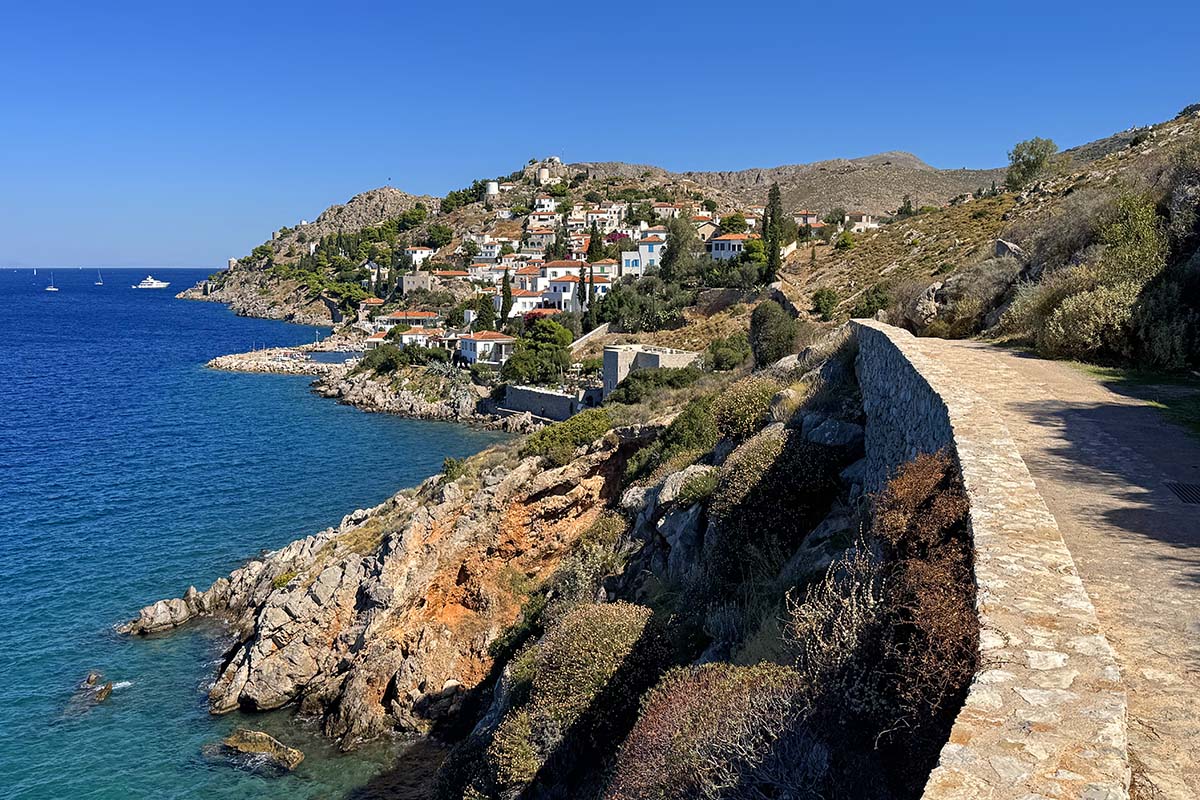
For a real Greek island experience within reach of Athens, Hydra is a wonderful choice. Think narrow streets, donkeys instead of cars, swimming spots, and seaside tavernas where you can enjoy a leisurely lunch. It feels completely different from the city.
We visited independently, taking a ferry from Piraeus to Hydra. Piraeus is easy to reach by metro, making this straightforward to organize. Allow a full day, ferry included. We visited in October, when ferries run on a low-season schedule, and we had just six hours on the island, but it was perfect.
There are also plenty of island tours from Athens, including cruises visiting several islands in one day. But we were happy to spend our time on Hydra rather than squeeze in more stops.
Our take: We LOVED Hydra. It was one of the most enjoyable days of our trip, and we’d definitely recommend it, especially if you’re visiting between April and October and have an extra day to spare.
Cape Sounion & the Temple of Poseidon
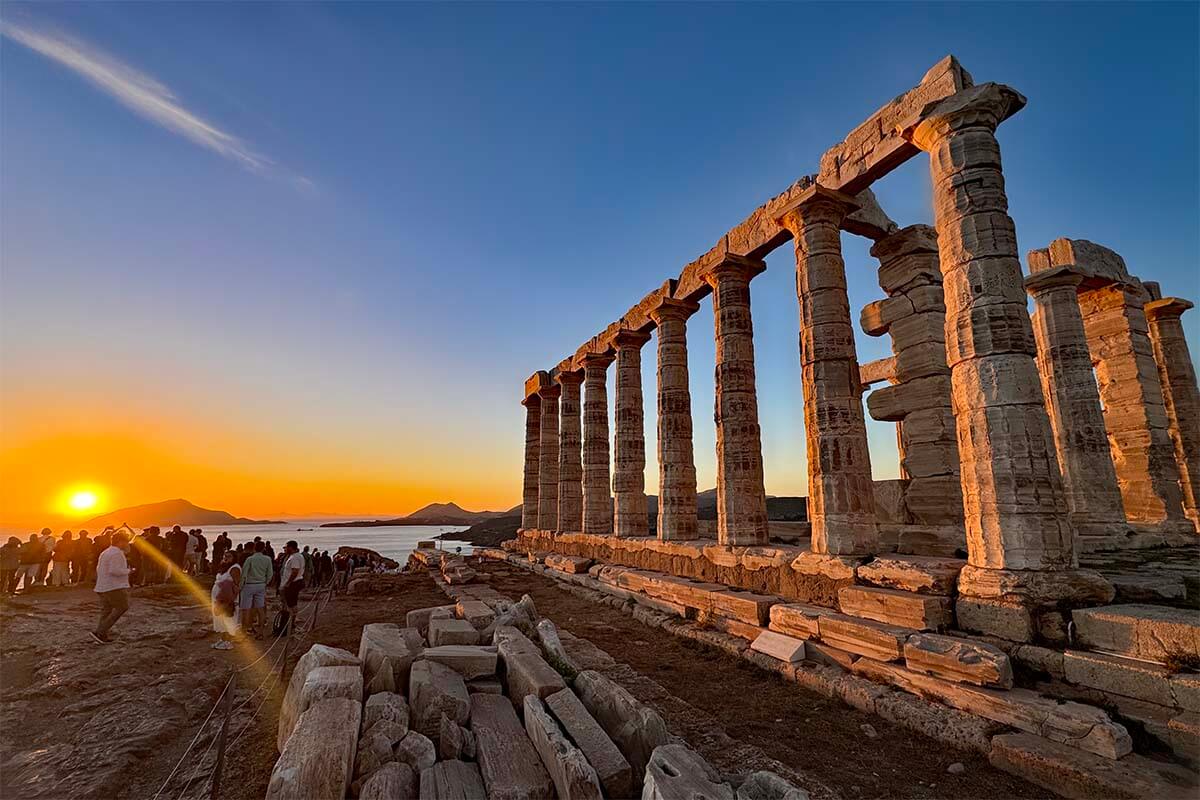
Cape Sounion is a popular excursion from Athens, best known for the Temple of Poseidon, an ancient Greek temple overlooking the Aegean Sea. Its setting is especially beautiful around sunset.
We took this sunset tour from Athens. It was a nice addition to our itinerary, although we felt it involved a lot of driving for a relatively short visit. On the plus side, it leaves your morning free for sightseeing, and some time to rest on the bus can be welcome after all the walking.
Time needed: Late afternoon and evening. We spent about 3.5 hours on the bus and 2 hours at Cape Sounion, which was more than enough time there.
Our take: Nice if you have a free afternoon, but I wouldn’t prioritize it with only a day or two in Athens. Meteora was much more worth the long drive, and Hydra was more relaxed overall. Cape Sounion is a good option if you want to escape the city for a few hours.
So, these are our favorite things to do in Athens and the places we’d recommend based on our own trip. Make sure to leave some time between the main sights for neighborhood walks, good food, and a rooftop drink with an Acropolis view. For us, those moments were just as memorable as the famous landmarks, and the day trips outside the city made the visit so much more special.
We hope our tips help you make the most of your time in Athens!
TIP: Save this guide for later, share it with your friends, or pin it to Pinterest so you can easily come back to it when planning your trip.